Foram encontradas 240 questões.
Texto II
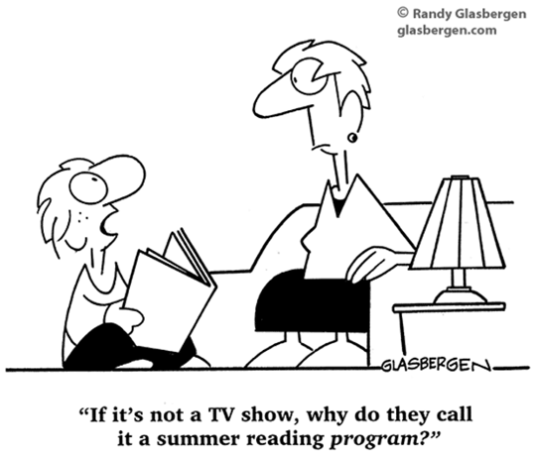
(Adapted from: https://www.glasbergen.com/ngg_tag/funnycartoons-
about-reading/. Accessed Oct 19 2019.)
Na sentença "If it's not a TV show, why do they call it a summer reading program?", pode-se afirmar que o termo "it" constrói, com a expressão “summer reading program”, uma relação de coesão:
Provas

Texto II
(Adapted from: https://www.glasbergen.com/ngg_tag/funnycartoons-
about-reading/. Accessed Oct 19 2019.)
No Texto II, o efeito de humor é construído a partir:
Provas
Texto I
GRAMMAR INSTRUCTION
As a result of the communicative revolution in language teaching, it has become increasingly clear that grammar is a tool or resource to be used in the comprehension and creation of oral and written discourse rather than something to be learned as an end in itself. When learned as a decontextualized sentence-level system, grammar is not very useful to learners as they listen, read, speak, and write in their second or foreign language. Indeed, as Canale and Swain (1980) have posited, communicative competence consists of four components, only one of which – Item 3 below – involves grammar:
1. Sociolinguistic competence (i.e., appropriacy): The speaker/ writer knows how to express the message in terms of the person being addressed and the overall circumstances and purpose of the communication.
2. Discourse competence: The selection, sequence, and arrangement of words and structures are clear and effective means of expressing the speaker/writer's intended message.
3. Linguistic competence (i.e., accuracy): The forms, inflections, and sequences used to express the message are grammatically correct.
4. Strategic competence: The speaker/writer has effective and unobtrusive strategies to compensate for any weaknesses s/he has in the above three areas.
Certainly, in many person-to-person communications, sociolinguistic appropriacy and discourse competence are more important than grammatical accuracy, provided that the grammar used is not inaccurate to the point of miscommunicating the intended message; communication is the overriding concern. However, there are situations where a reasonable degree of accuracy is also critical, and this is our current focus.
In order for ESL/EFL teachers to consistently present grammar as serving some higher-order objective, Celce-Murcia and Hilles (1988) suggest that grammar should never be taught as an end in itself but always with reference to meaning, social factors, or discourse – or a combination of these factors. Larsen-Freeman's (1991) position is similar: She sees form, meaning, and function as three interacting dimensions of language; the classroom teacher must decide in which dimension the students are experiencing the greatest learning challenge at any given moment and respond with appropriate instruction.
(Adapted from: CELCE-MURCIA, M. Grammar Pedagogy in Second and Foreign Language Teaching. TESOL Quarterly, 25(3), 459, 1991.)
No enunciado "The speaker/writer has effective and unobtrusive strategies to compensate for any weaknesses s/he has in the above three areas", o termo em destaque pode ser compreendido como:
Provas
Texto I
GRAMMAR INSTRUCTION
As a result of the communicative revolution in language teaching, it has become increasingly clear that grammar is a tool or resource to be used in the comprehension and creation of oral and written discourse rather than something to be learned as an end in itself. When learned as a decontextualized sentence-level system, grammar is not very useful to learners as they listen, read, speak, and write in their second or foreign language. Indeed, as Canale and Swain (1980) have posited, communicative competence consists of four components, only one of which – Item 3 below – involves grammar:
1. Sociolinguistic competence (i.e., appropriacy): The speaker/ writer knows how to express the message in terms of the person being addressed and the overall circumstances and purpose of the communication.
2. Discourse competence: The selection, sequence, and arrangement of words and structures are clear and effective means of expressing the speaker/writer's intended message.
3. Linguistic competence (i.e., accuracy): The forms, inflections, and sequences used to express the message are grammatically correct.
4. Strategic competence: The speaker/writer has effective and unobtrusive strategies to compensate for any weaknesses s/he has in the above three areas.
Certainly, in many person-to-person communications, sociolinguistic appropriacy and discourse competence are more important than grammatical accuracy, provided that the grammar used is not inaccurate to the point of miscommunicating the intended message; communication is the overriding concern. However, there are situations where a reasonable degree of accuracy is also critical, and this is our current focus.
In order for ESL/EFL teachers to consistently present grammar as serving some higher-order objective, Celce-Murcia and Hilles (1988) suggest that grammar should never be taught as an end in itself but always with reference to meaning, social factors, or discourse – or a combination of these factors. Larsen-Freeman's (1991) position is similar: She sees form, meaning, and function as three interacting dimensions of language; the classroom teacher must decide in which dimension the students are experiencing the greatest learning challenge at any given moment and respond with appropriate instruction.
(Adapted from: CELCE-MURCIA, M. Grammar Pedagogy in Second and Foreign Language Teaching. TESOL Quarterly, 25(3), 459, 1991.)
Das sentenças a seguir, a que melhor resume o papel da gramática no ensino-aprendizagem de uma língua, de acordo com o Texto I, é:
Provas
Texto I
GRAMMAR INSTRUCTION
As a result of the communicative revolution in language teaching, it has become increasingly clear that grammar is a tool or resource to be used in the comprehension and creation of oral and written discourse rather than something to be learned as an end in itself. When learned as a decontextualized sentence-level system, grammar is not very useful to learners as they listen, read, speak, and write in their second or foreign language. Indeed, as Canale and Swain (1980) have posited, communicative competence consists of four components, only one of which – Item 3 below – involves grammar:
1. Sociolinguistic competence (i.e., appropriacy): The speaker/ writer knows how to express the message in terms of the person being addressed and the overall circumstances and purpose of the communication.
2. Discourse competence: The selection, sequence, and arrangement of words and structures are clear and effective means of expressing the speaker/writer's intended message.
3. Linguistic competence (i.e., accuracy): The forms, inflections, and sequences used to express the message are grammatically correct.
4. Strategic competence: The speaker/writer has effective and unobtrusive strategies to compensate for any weaknesses s/he has in the above three areas.
Certainly, in many person-to-person communications, sociolinguistic appropriacy and discourse competence are more important than grammatical accuracy, provided that the grammar used is not inaccurate to the point of miscommunicating the intended message; communication is the overriding concern. However, there are situations where a reasonable degree of accuracy is also critical, and this is our current focus.
In order for ESL/EFL teachers to consistently present grammar as serving some higher-order objective, Celce-Murcia and Hilles (1988) suggest that grammar should never be taught as an end in itself but always with reference to meaning, social factors, or discourse – or a combination of these factors. Larsen-Freeman's (1991) position is similar: She sees form, meaning, and function as three interacting dimensions of language; the classroom teacher must decide in which dimension the students are experiencing the greatest learning challenge at any given moment and respond with appropriate instruction.
(Adapted from: CELCE-MURCIA, M. Grammar Pedagogy in Second and Foreign Language Teaching. TESOL Quarterly, 25(3), 459, 1991.)
O principal objetivo do Texto I é:
Provas
O Artigo 157 da Lei nº 5.956/2015, Lei da Gestão Democrática do Município de Cuiabá, versa sobre a autonomia da gestão pedagógica e “estabelece princípios e regras, reconhecendo os valores e o contexto em que a unidade educacional está inserida”. Porém, o parágrafo único desse artigo, esclarece que essa autonomia é relativa, considerando que o projeto político-pedagógico deve estar:
Provas
Os Parâmetros Curriculares Nacionais constituem o primeiro nível de concretização curricular e por sua natureza aberta configuram:
Provas
Déborah foi aprovada em concurso para a carreira do magistério do município de Cuiabá e, após o período legal, veio a ser confirmada no cargo e requereu promoção. Nos termos da Lei municipal, a promoção dar-se-á em virtude da nova habilitação ou titulação, imediatamente superior ao que ocupa na carreira, devidamente comprovada. Trata-se da promoção de:
Provas
Diego foi eleito vereador do município de Cuiabá e não pôde comparecer à sessão solene de posse, por motivos familiares. De acordo com a Lei Orgânica do Município de Cuiabá, caso não haja posse do vereador no prazo legal ocorrerá a perda do mandato, salvo justo motivo aceito:
Provas
Um mercado vende água somente em garrafas que contém 2 ou 5 litros e no estoque há um total de 80 dessas garrafas que totalizam 250 litros de água. Se n representa a quantidade de litros de água armazenada apenas nas garrafas de 5 litros, o valor de n é igual a:
Provas
Caderno Container