Foram encontradas 40 questões.
Provas

Provas
( ) A função “PRI.MAIÚSCULA” coloca a primeira letra de uma cadeia de texto em maiúscula e todas as outras letras do texto depois de qualquer caractere diferente de uma letra.
( ) A função “DIA.DA.SEMANA” retorna uma string (conjunto de caracteres, por exemplo, “segunda”) com o texto do dia da semana correspondente a uma data.
( ) A função “ARRUMAR” remove todos os espaços de texto, exceto os espaços únicos entre palavras.
Assinale a sequência correta.
Provas
I. O usuário pode utilizar os recursos somente o tempo que precisar, porém deve pagar pela licença em tempo integral, como no modelo tradicional.
II. O fornecedor do serviço de cloud computing é quem se encarrega de aperfeiçoar, corrigir falhas e aumentar o desempenho da aplicação, sempre que necessário.
III. O usuário não precisa se preocupar com o hardware, com procedimentos de backup nem de controle de segurança da aplicação contratada.
Estão corretas as afirmativas
Provas
Provas
Learning goals, which are referred to in version 3 of the BNCC as abilities, are intended to list the basic knowledge to be acquired by students, and to serve as a reference for drafting and updating the regional, state and municipal curricula. […]
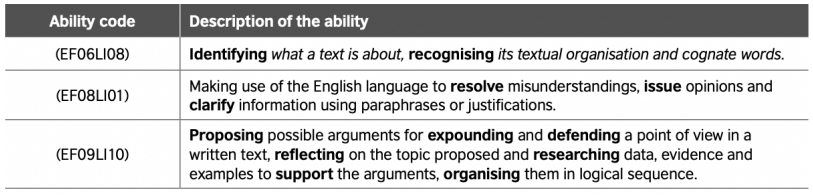
Available at: https://www.britishcouncil.org.br/sites/default/files/leitura_critica_bncc_-_en_-_v4_final.pdf. [Fragment] Accessed on: April 26, 2022.
Cognates are words in two languages that share a similar meaning, spelling, and pronunciation. Researchers who study first and second language acquisition have found that students benefit from cognate awareness. Cognate awareness is the ability to use cognates in a primary language as a tool for understanding a second language. To develop the BNCC ability EF06LI08, which includes recognizing cognate words, an English teacher, when working with a group of beginners, may
Provas

Available at: https://newh.org/news/back-to-school/. Accessed on: April 26, 2022.
Provas
Available at: https://newh.org/news/back-to-school/. Accessed on: April 26, 2022.
Provas
By Clare Lavery
Keeping students’ attention and stopping them from getting distracted is a big challenge. Here are some reasons why students’ attention may wander and ways to keep your classes on track.
• Keep in control. Anticipation is the best form of
teacher defence so keep scanning the room,
making eye contact with all students. You will
catch those who are starting to fidget, look out of
window or chat to their mates. Then you can react
accordingly before the noise level has distracted
everyone and created a situation.
• Keep in tune with the class. Don’t just glide
along with the best. If one student answers your
questions this is not proof that all the others
are following what is being discussed. Aim for
responses from as wide a sample as possible.
Don’t just accept answers from the 3 or 4 class
leaders or you will leave the rest behind.
• Keep checking understanding. Try not to use
questions like “Do you understand?” or “Has
everyone got that?” Students are notoriously wary
of admitting they haven’t understood, especially
if their peers are feigning comprehension!
Use further questions to see if they have
understood the concepts.
• Keep demonstrating. Attention wanders when
they don’t know what to do and are too afraid
to admit it. Keep your instructions to a minimum
and demonstrate what to do rather than giving
lengthy or detailed explanations. If nearly half of
them are clearly unsure and starting to flounder
or chat in their mother tongue, take action.
Call on the pairs who are doing the task
successfully to demonstrate their work as an
example for others then try again.
Changing the pace
Here are some tried and tested techniques for changing the pace of the lesson to keep students awake.
• Chant. Select a weekly chant which rouses
students. Students stand or sit, clap along or
snap their fingers and repeat the rap you have
devised. This can be a quotation for higher levels
or a sentence construction covered by lower
levels. Make it short, snappy and fun.
• Drill. Use some quick-fire questioning around
the class and involve as many as possible.
Then get the students to do the questions as well
as supplying answers. Use visuals as prompts
for this questioning.
• Play a game. Do a 10-minute revision game
involving everyone pooling ideas, words or
questions. Even a spelling game for beginners
does the trick. Word association or memory
games work well!
• Give a dictation. They do have to concentrate
here! It might be just a short piece of text or a list
of words. It could be some lines from a song in
the charts.
Available at: https://www.teachingenglish.org.uk/article/ strategies-keeping-attention. Accessed on: April 26, 2022
Provas
By Clare Lavery
Keeping students’ attention and stopping them from getting distracted is a big challenge. Here are some reasons why students’ attention may wander and ways to keep your classes on track.
• Keep in control. Anticipation is the best form of
teacher defence so keep scanning the room,
making eye contact with all students. You will
catch those who are starting to fidget, look out of
window or chat to their mates. Then you can react
accordingly before the noise level has distracted
everyone and created a situation.
• Keep in tune with the class. Don’t just glide
along with the best. If one student answers your
questions this is not proof that all the others
are following what is being discussed. Aim for
responses from as wide a sample as possible.
Don’t just accept answers from the 3 or 4 class
leaders or you will leave the rest behind.
• Keep checking understanding. Try not to use
questions like “Do you understand?” or “Has
everyone got that?” Students are notoriously wary
of admitting they haven’t understood, especially
if their peers are feigning comprehension!
Use further questions to see if they have
understood the concepts.
• Keep demonstrating. Attention wanders when
they don’t know what to do and are too afraid
to admit it. Keep your instructions to a minimum
and demonstrate what to do rather than giving
lengthy or detailed explanations. If nearly half of
them are clearly unsure and starting to flounder
or chat in their mother tongue, take action.
Call on the pairs who are doing the task
successfully to demonstrate their work as an
example for others then try again.
Changing the pace
Here are some tried and tested techniques for changing the pace of the lesson to keep students awake.
• Chant. Select a weekly chant which rouses
students. Students stand or sit, clap along or
snap their fingers and repeat the rap you have
devised. This can be a quotation for higher levels
or a sentence construction covered by lower
levels. Make it short, snappy and fun.
• Drill. Use some quick-fire questioning around
the class and involve as many as possible.
Then get the students to do the questions as well
as supplying answers. Use visuals as prompts
for this questioning.
• Play a game. Do a 10-minute revision game
involving everyone pooling ideas, words or
questions. Even a spelling game for beginners
does the trick. Word association or memory
games work well!
• Give a dictation. They do have to concentrate
here! It might be just a short piece of text or a list
of words. It could be some lines from a song in
the charts.
Available at: https://www.teachingenglish.org.uk/article/ strategies-keeping-attention. Accessed on: April 26, 2022
Provas
Caderno Container