Foram encontradas 265 questões.
Uma das tarefas inerentes à alfabetização matemática é a identificação do conjunto ao qual certo número pertence. Em especial, quando se fala do Conjunto dos Números Naturais, caracterizam-se os elementos de contagem que têm grande relevância para a resolução de problemas e aplicações. Nesse contexto, identifique, entre os números a seguir, o único pertencente ao Conjunto dos Números Naturais.
Provas

Em sua profissão, o professor é constantemente questionado a respeito de memes da internet, especialmente os que têm estruturas mais simples, envolvendo apenas os números inteiros e as quatro operações. A expressão a seguir é exemplo disso, colocando o observador desatento em uma situação desconfortável e induzindo-o a erro:
\( 4 \)\( 8 \) ÷ \( 3 \) × (\( 4 \) + \( 1 \)\( 2 \))
Resolvendo essa expressão corretamente, deve-se chegar ao número
Provas
Sabendo que \( a \), \( b \) e \( c \) são números tais que \( a \) × \( b \) × \( c \) = \( 8 \)\( 4 \)\( 0 \) com \( \dfrac{a}{3}=\dfrac{b}{5}=\dfrac{c}{7} \), então pode-se dizer que \( a \) + \( b \) + \( c \) é igual a
Provas
Considerando as propriedades de potência e seus radicais, ao resolver a igualdade a seguir:
\( 9 \)\( 2 \)\( x \)−\( 1 \) = \( 3 \)\( 6 \)\( x \)
encontramos um valor para \( x \) tal que
Provas
Disciplina: Inglês (Língua Inglesa)
Banca: AOCP
Orgão: Pref. Vitória Conquista-BA
Note: throughout the test, you are going to read an online article entitled Bing A.I. and the Dawn of the Post-Search Internet (written by Kyle Chayka), adapted from https://www.newyorker.com and accessed on 11 June 2023. The article is about Artificial Intelligence (A.I.) and it discusses ChatGPT.
All the questions of your test will refer to different parts and aspects of the article.
You, as an English language teacher, establishes that your group’s following communicative objective is to make predictions about the future. In order to achieve that, you decide to work with the article Bing A.I. and the Dawn of the Post-Search Internet to develop reading skills and also to work with the structure Future Simple with Will to make future predictions. After teaching and practicing the target language, you ask students to produce an infographic with future predictions on different areas. As far as assessment is concerned, all the alternatives below are accurate, EXCEPT
Provas
Disciplina: Inglês (Língua Inglesa)
Banca: AOCP
Orgão: Pref. Vitória Conquista-BA
Note: throughout the test, you are going to read an online article entitled Bing A.I. and the Dawn of the Post-Search Internet (written by Kyle Chayka), adapted from https://www.newyorker.com and accessed on 11 June 2023. The article is about Artificial Intelligence (A.I.) and it discusses ChatGPT.
All the questions of your test will refer to different parts and aspects of the article.
When discussing the typical sequence of an English language lesson, Scrivener (2011), proposes the following diagram:
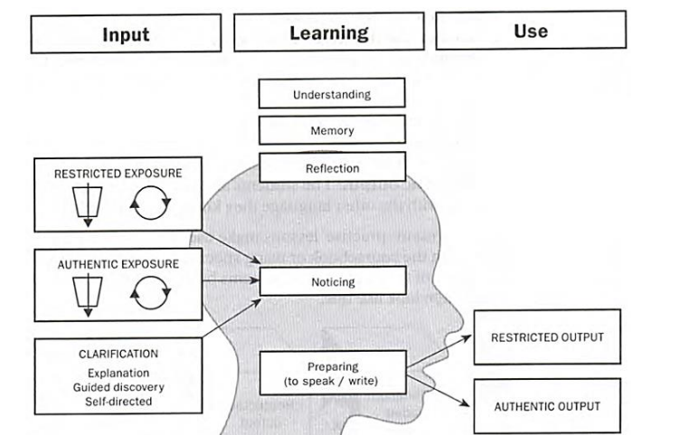
Source: Scrivener (2011, p. 159).
You, as an English language teacher, establishes that your group’s following communicative objective is to make predictions about the future. In order to achieve that, you decide to work with the article Bing A.I. and the Dawn of the Post-Search Internet to develop reading skills and also to work with the structure Future Simple with Will to make future predictions. Considering this classroom situation and Scrivener’s diagram, analyze the following statements.
I. The article functions as input material, once students are exposed to the target language, in this case, will for future predictions.
II. The teacher draws students’ attention to part of the text and asks students to find one prediction the author is making about the future. Students identify it. This step of the lesson is what Scrivener calls self-directed clarification in his diagram, once students work completely autonomously, without the teacher’s intervention.
III. The teacher draws students’ attention to other two model sentences of future prediction from the text. Then, the teacher asks questions such as Are we talking about a present, past or future situation?; How do you know it’s future?; So when we want to make a prediction about the future, what do we use?. This is what Scrivener calls, in his diagram, guided-discovery clarification and the questions used by the teacher are called concept-checking questions.
IV. The teacher carries out some drilling exercises to systematize the target language. Then, the teacher asks students to produce an infographic making predictions for the future. The first practice, the drilling exercises, is what Scrivener calls in his diagram authentic output, or freer practice, while the infographic is what he calls restricted output, or controlled practice.
It is completely accurate what is stated in
Provas
Disciplina: Inglês (Língua Inglesa)
Banca: AOCP
Orgão: Pref. Vitória Conquista-BA
Note: throughout the test, you are going to read an online article entitled Bing A.I. and the Dawn of the Post-Search Internet (written by Kyle Chayka), adapted from https://www.newyorker.com and accessed on 11 June 2023. The article is about Artificial Intelligence (A.I.) and it discusses ChatGPT.
All the questions of your test will refer to different parts and aspects of the article.
When setting up a task, the teacher has to consider and plan how to do a number of things: giving instructions, checking instructions, monitoring and giving feedback. You, an English language teacher, is setting up a reading task for the article Bing A.I. and the Dawn of the Post-Search Internet. Match the functions listed A – I with the examples of teachers’ language. There are three extra functions which you do NOT need to use.
Functions
A. Asking students to speculate and make predictions.
B. Checking instructions.
C. Giving feedback.
D. Correcting students.
E. Grouping students.
F. Personalizing.
G. Activating students’ schemata.
H. Giving instructions.
I. Prompting.
Examples of teachers’ language
( ) What do you know about ChatGPT?
( ) Now work with the classmate sitting next to you and compare your answers. Justify them using the text.
( ) Do you have to summarize the details of the text of just the main ideas?
( ) Now that we read the article, do you think you will use ChatGPT instead of Google Search? Why (not)?
( ) You summarized the main idea of your part of the text really well. Good job.
( ) You have to compare Google Search and ChatGPT, right? So, Google Search gives you lots of results and you choose what you need and ChatGPT…
Provas
Disciplina: Inglês (Língua Inglesa)
Banca: AOCP
Orgão: Pref. Vitória Conquista-BA
Note: throughout the test, you are going to read an online article entitled Bing A.I. and the Dawn of the Post-Search Internet (written by Kyle Chayka), adapted from https://www.newyorker.com and accessed on 11 June 2023. The article is about Artificial Intelligence (A.I.) and it discusses ChatGPT.
All the questions of your test will refer to different parts and aspects of the article.
You, as an English language teacher, decided to work with the article Bing A.I. and the Dawn of the Post-Search Internet with your students. The first reading task you ask students to complete is for them to understand just the main ideas, that is, the global message of the text. The reading skill being developed by doing this task is called
Provas
Disciplina: Inglês (Língua Inglesa)
Banca: AOCP
Orgão: Pref. Vitória Conquista-BA
Note: throughout the test, you are going to read an online article entitled Bing A.I. and the Dawn of the Post-Search Internet (written by Kyle Chayka), adapted from https://www.newyorker.com and accessed on 11 June 2023. The article is about Artificial Intelligence (A.I.) and it discusses ChatGPT.
All the questions of your test will refer to different parts and aspects of the article.
Read the final part of the article. Choose the alternative with the prepositions and verb forms which accurately complete the gaps, respectively.
_____ the meantime, non-automated text online will become an artisanal good, a product that we seek out for its unadulterated quality: instead _____ natural wine, “natural language.” On Tuesday, Google announced the release of its own A.I. chatbot. Called Bard—a more evocative and lofty title than Microsoft’s dry “A.I.-powered copilot”—it amounts to a broadside in the A.I. arms race among tech giants. But Google has conspicuously kept the chatbot separate _____ its signature product. “We think of Bard as complementary to Google Search,” one company executive told the Times. It’s a tacit acknowledgment of A.I.’s threat to the company’s current model. In its race to catch _____ with Microsoft, Google must try to avoid cannibalizing itself. Bing, however, is cheerily ushering us into the post-search future.
Provas
Disciplina: Inglês (Língua Inglesa)
Banca: AOCP
Orgão: Pref. Vitória Conquista-BA
Note: throughout the test, you are going to read an online article entitled Bing A.I. and the Dawn of the Post-Search Internet (written by Kyle Chayka), adapted from https://www.newyorker.com and accessed on 11 June 2023. The article is about Artificial Intelligence (A.I.) and it discusses ChatGPT.
All the questions of your test will refer to different parts and aspects of the article.
Read the fifth part of the article. Which of the underlined modal verbs is closest in meaning to the modal verb ‘may’ in the context of the text?
Speaking of fresh and reliable material, what happens when more and more of the material found online is generated by artificial intelligence? Last week, Google and Microsoft both announced a suite of A.I. tools for office workers, with applications that can compose new e-mails, reports, and slide decks or summarize existing ones. Similar tools must soon be invading other aspects of our digital lives. When the bot is generating material that workers used to produce, it will become difficult to determine which pieces of content in your in-box are meaningful; there will be no guarantee that any human labor or thought went into a given e-mail or report. We are all already bombarded by spam, mostly of a man-made variety. This will be a new kind of A.I.-generated spam on an unprecedented scale, much of it difficult to distinguish from content made by humans. Sooner than we think, content mills may be using A.I. to generate full articles, publicists may be using it to write press releases, and cooking sites might use it to devise recipes. These companies had better provide help for people to navigate the glut, but media companies will have fewer resources to devote to serving that need. In such a scenario, A.I. could solve the very problem that it creates: eventually, if tools like Bing A.I. cause the well of original material online to run dry, all that will be left is self-referential bots, dredging up a generic set of answers that machines created in the first place.
Provas
Caderno Container