Foram encontradas 45.388 questões.
Texto para a questão
Rain Is Coming to Burning Los Angeles and Will Bring Its Own Risks
Rain is forecast to begin as soon as Saturday afternoon and to continue as late as Monday evening, says meteorologist Kristan Lund of the National Weather Service’s Los Angeles office. The area desperately needs the precipitation, but experts are warily monitoring the situation because rain poses its own risks in recently burned areas— most notably the potential occurrence of mudslides and similar hazards. “Rain is good because we’ve been so dry,” Lund says. “However, if we get heavier rain rates or we get the thunderstorms, it’s actually a lot more dangerous because you can get debris flows.”
Fires do a couple of different things to the landscape that can increase the risk of burned material, soil and detritus hurtling out of control. When fires burn hot or long enough, they leave an invisible layer of waxy material just under the surface of the ground. This develops from decomposing leaves and other organic material, which contain naturally hydrophobic or water-repellent compounds. Fire can vaporize this litter, and the resulting gas seeps into the upper soil—where it quickly cools and condenses, forming the slippery layer.
When rain falls on ground that has been affected by this phenomenon, it can’t sink beyond the hydrophobic layer— so the water flows away, often hauling debris with it. “All of the trees, branches, everything that’s been burned—unfortunately, if it rains, that stuff just floats,” Lund says. “It’s really concerning.” Even a fire that isn’t severe enough to create a hydrophobic layer can still cause debris flows, says Danielle Touma, a climate scientist at the University of Texas at Austin. Under normal conditions, trees and other plants usually trap some rain above the surface, slowing the water’s downward journey. But on freshly burned land there’s much less greenery to interfere; all the rain immediately hits the ground. [...]
Fortunately, the rain should also help firefighters tame the blazes that remain active. The largest, the Palisades Fire, is currently 77 percent contained. The second largest, the Eaton Fire, is 95 percent contained. The Hughes Fire is third largest and only 56 percent contained. A fire can be fully contained but still burning. The containment percentage refers to the amount of the perimeter that has barriers that firefighters expect will prevent further spread.
Scientific American. January 27th, 2025. Adaptado.
Provas
Questão presente nas seguintes provas

Rain Is Coming to Burning Los Angeles and Will Bring Its Own Risks
Rain is forecast to begin as soon as Saturday
afternoon and to continue as late as Monday evening, says
meteorologist Kristan Lund of the National Weather Service’s
Los Angeles office. The area desperately needs the
precipitation, but experts are warily monitoring the situation
because rain poses its own risks in recently burned areas—
most notably the potential occurrence of mudslides and similar
hazards. “Rain is good because we’ve been so dry,” Lund
says. “However, if we get heavier rain rates or we get the
thunderstorms, it’s actually a lot more dangerous because you
can get debris flows.”
Fires do a couple of different things to the landscape
that can increase the risk of burned material, soil and detritus
hurtling out of control. When fires burn hot or long enough, they
leave an invisible layer of waxy material just under the surface
of the ground. This develops from decomposing leaves and
other organic material, which contain naturally hydrophobic or
water-repellent compounds. Fire can vaporize this litter, and
the resulting gas seeps into the upper soil—where it quickly
cools and condenses, forming the slippery layer.
When rain falls on ground that has been affected by
this phenomenon, it can’t sink beyond the hydrophobic layer—
so the water flows away, often hauling debris with it. “All of the
trees, branches, everything that’s been burned—unfortunately,
if it rains, that stuff just floats,” Lund says. “It’s really
concerning.” Even a fire that isn’t severe enough to create a
hydrophobic layer can still cause debris flows, says Danielle
Touma, a climate scientist at the University of Texas at Austin.
Under normal conditions, trees and other plants usually trap
some rain above the surface, slowing the water’s downward
journey. But on freshly burned land there’s much less greenery
to interfere; all the rain immediately hits the ground. [...]
Fortunately, the rain should also help firefighters tame
the blazes that remain active. The largest, the Palisades Fire,
is currently 77 percent contained. The second largest, the
Eaton Fire, is 95 percent contained. The Hughes Fire is third
largest and only 56 percent contained. A fire can be fully
contained but still burning. The containment percentage refers
to the amount of the perimeter that has barriers that firefighters
expect will prevent further spread.
Scientific American. January 27th, 2025. Adaptado.
Provas
Questão presente nas seguintes provas
Rain Is Coming to Burning Los Angeles and Will Bring Its Own Risks
Rain is forecast to begin as soon as Saturday
afternoon and to continue as late as Monday evening, says
meteorologist Kristan Lund of the National Weather Service’s
Los Angeles office. The area desperately needs the
precipitation, but experts are warily monitoring the situation
because rain poses its own risks in recently burned areas—
most notably the potential occurrence of mudslides and similar
hazards. “Rain is good because we’ve been so dry,” Lund
says. “However, if we get heavier rain rates or we get the
thunderstorms, it’s actually a lot more dangerous because you
can get debris flows.”
Fires do a couple of different things to the landscape
that can increase the risk of burned material, soil and detritus
hurtling out of control. When fires burn hot or long enough, they
leave an invisible layer of waxy material just under the surface
of the ground. This develops from decomposing leaves and
other organic material, which contain naturally hydrophobic or
water-repellent compounds. Fire can vaporize this litter, and
the resulting gas seeps into the upper soil—where it quickly
cools and condenses, forming the slippery layer.
When rain falls on ground that has been affected by
this phenomenon, it can’t sink beyond the hydrophobic layer—
so the water flows away, often hauling debris with it. “All of the
trees, branches, everything that’s been burned—unfortunately,
if it rains, that stuff just floats,” Lund says. “It’s really
concerning.” Even a fire that isn’t severe enough to create a
hydrophobic layer can still cause debris flows, says Danielle
Touma, a climate scientist at the University of Texas at Austin.
Under normal conditions, trees and other plants usually trap
some rain above the surface, slowing the water’s downward
journey. But on freshly burned land there’s much less greenery
to interfere; all the rain immediately hits the ground. [...]
Fortunately, the rain should also help firefighters tame
the blazes that remain active. The largest, the Palisades Fire,
is currently 77 percent contained. The second largest, the
Eaton Fire, is 95 percent contained. The Hughes Fire is third
largest and only 56 percent contained. A fire can be fully
contained but still burning. The containment percentage refers
to the amount of the perimeter that has barriers that firefighters
expect will prevent further spread.
Scientific American. January 27th, 2025. Adaptado.
Provas
Questão presente nas seguintes provas
- Interpretação de texto | Reading comprehension
- Gramática - Língua InglesaPalavras conectivas | Connective words
Rain Is Coming to Burning Los Angeles and Will Bring Its Own Risks
Rain is forecast to begin as soon as Saturday
afternoon and to continue as late as Monday evening, says
meteorologist Kristan Lund of the National Weather Service’s
Los Angeles office. The area desperately needs the
precipitation, but experts are warily monitoring the situation
because rain poses its own risks in recently burned areas—
most notably the potential occurrence of mudslides and similar
hazards. “Rain is good because we’ve been so dry,” Lund
says. “However, if we get heavier rain rates or we get the
thunderstorms, it’s actually a lot more dangerous because you
can get debris flows.”
Fires do a couple of different things to the landscape
that can increase the risk of burned material, soil and detritus
hurtling out of control. When fires burn hot or long enough, they
leave an invisible layer of waxy material just under the surface
of the ground. This develops from decomposing leaves and
other organic material, which contain naturally hydrophobic or
water-repellent compounds. Fire can vaporize this litter, and
the resulting gas seeps into the upper soil—where it quickly
cools and condenses, forming the slippery layer.
When rain falls on ground that has been affected by
this phenomenon, it can’t sink beyond the hydrophobic layer—
so the water flows away, often hauling debris with it. “All of the
trees, branches, everything that’s been burned—unfortunately,
if it rains, that stuff just floats,” Lund says. “It’s really
concerning.” Even a fire that isn’t severe enough to create a
hydrophobic layer can still cause debris flows, says Danielle
Touma, a climate scientist at the University of Texas at Austin.
Under normal conditions, trees and other plants usually trap
some rain above the surface, slowing the water’s downward
journey. But on freshly burned land there’s much less greenery
to interfere; all the rain immediately hits the ground. [...]
Fortunately, the rain should also help firefighters tame
the blazes that remain active. The largest, the Palisades Fire,
is currently 77 percent contained. The second largest, the
Eaton Fire, is 95 percent contained. The Hughes Fire is third
largest and only 56 percent contained. A fire can be fully
contained but still burning. The containment percentage refers
to the amount of the perimeter that has barriers that firefighters
expect will prevent further spread.
Scientific American. January 27th, 2025. Adaptado.
Provas
Questão presente nas seguintes provas
Rain Is Coming to Burning Los Angeles and Will Bring Its Own Risks
Rain is forecast to begin as soon as Saturday
afternoon and to continue as late as Monday evening, says
meteorologist Kristan Lund of the National Weather Service’s
Los Angeles office. The area desperately needs the
precipitation, but experts are warily monitoring the situation
because rain poses its own risks in recently burned areas—
most notably the potential occurrence of mudslides and similar
hazards. “Rain is good because we’ve been so dry,” Lund
says. “However, if we get heavier rain rates or we get the
thunderstorms, it’s actually a lot more dangerous because you
can get debris flows.”
Fires do a couple of different things to the landscape
that can increase the risk of burned material, soil and detritus
hurtling out of control. When fires burn hot or long enough, they
leave an invisible layer of waxy material just under the surface
of the ground. This develops from decomposing leaves and
other organic material, which contain naturally hydrophobic or
water-repellent compounds. Fire can vaporize this litter, and
the resulting gas seeps into the upper soil—where it quickly
cools and condenses, forming the slippery layer.
When rain falls on ground that has been affected by
this phenomenon, it can’t sink beyond the hydrophobic layer—
so the water flows away, often hauling debris with it. “All of the
trees, branches, everything that’s been burned—unfortunately,
if it rains, that stuff just floats,” Lund says. “It’s really
concerning.” Even a fire that isn’t severe enough to create a
hydrophobic layer can still cause debris flows, says Danielle
Touma, a climate scientist at the University of Texas at Austin.
Under normal conditions, trees and other plants usually trap
some rain above the surface, slowing the water’s downward
journey. But on freshly burned land there’s much less greenery
to interfere; all the rain immediately hits the ground. [...]
Fortunately, the rain should also help firefighters tame
the blazes that remain active. The largest, the Palisades Fire,
is currently 77 percent contained. The second largest, the
Eaton Fire, is 95 percent contained. The Hughes Fire is third
largest and only 56 percent contained. A fire can be fully
contained but still burning. The containment percentage refers
to the amount of the perimeter that has barriers that firefighters
expect will prevent further spread.
Scientific American. January 27th, 2025. Adaptado.
Provas
Questão presente nas seguintes provas
Rain Is Coming to Burning Los Angeles and Will Bring Its Own Risks
Rain is forecast to begin as soon as Saturday
afternoon and to continue as late as Monday evening, says
meteorologist Kristan Lund of the National Weather Service’s
Los Angeles office. The area desperately needs the
precipitation, but experts are warily monitoring the situation
because rain poses its own risks in recently burned areas—
most notably the potential occurrence of mudslides and similar
hazards. “Rain is good because we’ve been so dry,” Lund
says. “However, if we get heavier rain rates or we get the
thunderstorms, it’s actually a lot more dangerous because you
can get debris flows.”
Fires do a couple of different things to the landscape
that can increase the risk of burned material, soil and detritus
hurtling out of control. When fires burn hot or long enough, they
leave an invisible layer of waxy material just under the surface
of the ground. This develops from decomposing leaves and
other organic material, which contain naturally hydrophobic or
water-repellent compounds. Fire can vaporize this litter, and
the resulting gas seeps into the upper soil—where it quickly
cools and condenses, forming the slippery layer.
When rain falls on ground that has been affected by
this phenomenon, it can’t sink beyond the hydrophobic layer—
so the water flows away, often hauling debris with it. “All of the
trees, branches, everything that’s been burned—unfortunately,
if it rains, that stuff just floats,” Lund says. “It’s really
concerning.” Even a fire that isn’t severe enough to create a
hydrophobic layer can still cause debris flows, says Danielle
Touma, a climate scientist at the University of Texas at Austin.
Under normal conditions, trees and other plants usually trap
some rain above the surface, slowing the water’s downward
journey. But on freshly burned land there’s much less greenery
to interfere; all the rain immediately hits the ground. [...]
Fortunately, the rain should also help firefighters tame
the blazes that remain active. The largest, the Palisades Fire,
is currently 77 percent contained. The second largest, the
Eaton Fire, is 95 percent contained. The Hughes Fire is third
largest and only 56 percent contained. A fire can be fully
contained but still burning. The containment percentage refers
to the amount of the perimeter that has barriers that firefighters
expect will prevent further spread.
Scientific American. January 27th, 2025. Adaptado.
Provas
Questão presente nas seguintes provas
3683457
Ano: 2025
Disciplina: Inglês (Língua Inglesa)
Banca: FUNDATEC
Orgão: Câm. Cerro Grande-RS
Disciplina: Inglês (Língua Inglesa)
Banca: FUNDATEC
Orgão: Câm. Cerro Grande-RS
Provas:
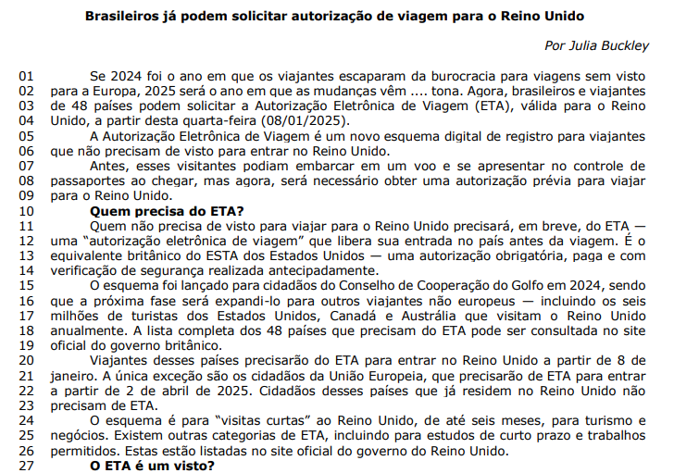

I. Em 2025, a exigência do ETA será exclusivamente para cidadãos da União Europeia, enquanto viajantes de outros continentes continuarão a entrar no Reino Unido sem a necessidade do visto e da autorização eletrônica.
II. A introdução do ETA para cidadãos da União Europeia ocorreu em janeiro de 2025, sem exceções para residentes do Reino Unido após a expansão do esquema para 48 países.
III. O ETA é destinado a viagens de curto prazo, com duração de até seis meses, para turismo e negócios, mas também abrange outras categorias, como estudos e trabalho.
Quais estão corretas?
Provas
Questão presente nas seguintes provas
Which option is grammatically correct regarding the use of
verb tenses?
Provas
Questão presente nas seguintes provas
Which question is grammatically correct for the following answer?
“Nothing. I'll stay home with my cat.”
Provas
Questão presente nas seguintes provas
Read text Ill and answer question based on it.
Milly: “I'm from East Grinstead in West Sussex - probably about 50 minutes south of London. | guess it's kind of a country town, so a lot different from the busy capital. My hometown is quite green and nice. | like it. You go down the high street and everyone tends to know one another. It's homely and safe.”
Adapted from htips://www.bbc.com/Aleamingenglish
All adjectives below were used by Milly to describe her hometown, EXCEPT for:
Milly: “I'm from East Grinstead in West Sussex - probably about 50 minutes south of London. | guess it's kind of a country town, so a lot different from the busy capital. My hometown is quite green and nice. | like it. You go down the high street and everyone tends to know one another. It's homely and safe.”
Adapted from htips://www.bbc.com/Aleamingenglish
All adjectives below were used by Milly to describe her hometown, EXCEPT for:
Provas
Questão presente nas seguintes provas
Cadernos
Caderno Container