Foram encontradas 225 questões.
Como ferramenta de análise organizacional, o fluxograma apresenta as seguintes vantagens para a organização que o adota:
I. assegura a fluidez da movimentação de documentos e informações, mantendo claramente os limites do fluxo e dispondo de uma linguagem de leitura técnica que utiliza simbologia universalmente aceita;
II. dificulta a transferência de conhecimentos para outros agentes da mesma organização, ao estabelecer fluxos rígidos para as diversas atividades e documentos;
III. constrói uma uniformidade de comportamento, reduzindo os níveis de conflitos;
IV. fortalece o campo do aprendizado organizacional via informação, ao estruturar o conhecimento dos agentes e, por extensão, o da própria organização.
- Considerando as informações contidas nos itens acima, é correto afirmar que
Provas
Questão presente nas seguintes provas

Segundo Stephen Robbins, controle é o processo de monitorar as atividades para garantir que estejam sendo realizadas conforme planejado, de modo a corrigir quaisquer desvios importantes. Ainda de acordo com o mesmo autor, esse processo é constituído das etapas a seguir descritas:
I. estabelecimento de padrões de desempenho de acordo com os objetivos organizacionais;
II. mensuração do desempenho ideal;
III. comparação do desempenho real em relação ao padrão de desempenho estabelecido;
IV. tomada de ação gerencial para corrigir desvios ou padrões inadequados.
- Considerando as informações contidas nos itens acima, é correto afirmar que
Provas
Questão presente nas seguintes provas
Is Breakfast Overrated?
By Gretchen Reynolds
August 21, 2014
For years, we’ve heard that breakfast is the most important meal of the day. But scientific support for that idea has been surprisingly meager, and a spate of new research at several different universities — published in multiple articles in the August issue of The American Journal of Clinical Nutrition — could change the way we think about early-hours eating.
The largest and most provocative of the studies focused on whether breakfast plays a role in weight loss. Researchers at the University of Alabama at Birmingham and other institutions recruited nearly 300 volunteers who were trying to lose weight. They randomly assigned subjects to either skip breakfast, always eat the meal or continue with their current dietary habits. (Each group contained people who habitually ate or skipped breakfast at the start, so some changed habits, and others did not.)
Sixteen weeks later, the volunteers returned to the lab to be weighed. No one had lost much, only a pound or so per person, with weight in all groups unaffected by whether someone ate breakfast or skipped it.
In another new study — this one of lean volunteers — researchers at the University of Bath determined the resting metabolic rates, cholesterol levels and blood-sugar profiles of 33 participants and randomly assigned them to eat or skip breakfast. Volunteers were then provided with activity monitors.
After six weeks, their body weights, resting metabolic rates, cholesterol and most measures of blood sugar were about the same as they had been at the start, whether people ate breakfast or not. The one difference was that the breakfast eaters seemed to move around more during the morning; their activity monitors showed that volunteers in this group burned almost 500 calories more in light-intensity movement. But by eating breakfast, they also consumed an additional 500 calories each day. Contrary to popular belief, skipping breakfast had not driven volunteers to wolf down enormous lunches and dinners — but it had made them somewhat more sluggish first thing in the morning.
Together, the new research suggests that in terms of weight loss, “breakfast may be just another meal,” said Emily Dhurandhar, the assistant professor at the University of Alabama at Birmingham who led the study there. Skipping breakfast in these studies, she said, did not fatten people.
Each study was fairly short-term, however, and involved a limited range of volunteers. More randomized experiments are needed before we can fully understand the impact of breakfast, said James Betts, the professor who led the study of lean people. It’s not yet clear, for instance, whether heavy people’s bodies respond differently to morning meals than lean people’s, or if the timing and makeup of breakfast matters.
For now, the slightly unsatisfying takeaway from the new science would seem to be that if you like breakfast, fine; but if not, don’t sweat it. “I almost never have breakfast,” Dr. Betts said. “That was part of my motivation for conducting this research, as everybody was always telling me off and saying I should know better.” Based on the results of these studies, he said his habits won’t change.
Neither will those of Dr. Dhurandhar, who enjoys a morning meal. But, she said, “I guess I won’t nag my husband to eat breakfast anymore.”
(http://well.blogs.nytimes.com/2014/08/21/is-breakfast-overrated/??src=dayp&action=click&pgtype=Homepage&module=ccolumn- above-moth-fixed-region®ion=c-column-above-moth-fixed-region&WT.nav=c-column-above-moth-fixed-region)
The underlined word in “Volunteers were then provided with activity monitors.” (!$ 4^{th} !$ paragraph)
Provas
Questão presente nas seguintes provas
Is Breakfast Overrated?
By Gretchen Reynolds
August 21, 2014
For years, we’ve heard that breakfast is the most important meal of the day. But scientific support for that idea has been surprisingly meager, and a spate of new research at several different universities — published in multiple articles in the August issue of The American Journal of Clinical Nutrition — could change the way we think about early-hours eating.
The largest and most provocative of the studies focused on whether breakfast plays a role in weight loss. Researchers at the University of Alabama at Birmingham and other institutions recruited nearly 300 volunteers who were trying to lose weight. They randomly assigned subjects to either skip breakfast, always eat the meal or continue with their current dietary habits. (Each group contained people who habitually ate or skipped breakfast at the start, so some changed habits, and others did not.)
Sixteen weeks later, the volunteers returned to the lab to be weighed. No one had lost much, only a pound or so per person, with weight in all groups unaffected by whether someone ate breakfast or skipped it.
In another new study — this one of lean volunteers — researchers at the University of Bath determined the resting metabolic rates, cholesterol levels and blood-sugar profiles of 33 participants and randomly assigned them to eat or skip breakfast. Volunteers were then provided with activity monitors.
After six weeks, their body weights, resting metabolic rates, cholesterol and most measures of blood sugar were about the same as they had been at the start, whether people ate breakfast or not. The one difference was that the breakfast eaters seemed to move around more during the morning; their activity monitors showed that volunteers in this group burned almost 500 calories more in light-intensity movement. But by eating breakfast, they also consumed an additional 500 calories each day. Contrary to popular belief, skipping breakfast had not driven volunteers to wolf down enormous lunches and dinners — but it had made them somewhat more sluggish first thing in the morning.
Together, the new research suggests that in terms of weight loss, “breakfast may be just another meal,” said Emily Dhurandhar, the assistant professor at the University of Alabama at Birmingham who led the study there. Skipping breakfast in these studies, she said, did not fatten people.
Each study was fairly short-term, however, and involved a limited range of volunteers. More randomized experiments are needed before we can fully understand the impact of breakfast, said James Betts, the professor who led the study of lean people. It’s not yet clear, for instance, whether heavy people’s bodies respond differently to morning meals than lean people’s, or if the timing and makeup of breakfast matters.
For now, the slightly unsatisfying takeaway from the new science would seem to be that if you like breakfast, fine; but if not, don’t sweat it. “I almost never have breakfast,” Dr. Betts said. “That was part of my motivation for conducting this research, as everybody was always telling me off and saying I should know better.” Based on the results of these studies, he said his habits won’t change.
Neither will those of Dr. Dhurandhar, who enjoys a morning meal. But, she said, “I guess I won’t nag my husband to eat breakfast anymore.”
(http://well.blogs.nytimes.com/2014/08/21/is-breakfast-overrated/??src=dayp&action=click&pgtype=Homepage&module=ccolumn- above-moth-fixed-region®ion=c-column-above-moth-fixed-region&WT.nav=c-column-above-moth-fixed-region)
According to the research done at the University of Alabama at Birmingham, breakfast
Provas
Questão presente nas seguintes provas
Henri Fayol, um dos pioneiros da Administração Científica, é tido como o autor da clássica divisão das funções do administrador, qual seja,
I. planejar, organizar, dirigir e controlar.
II. planejar, organizar, coordenar, comandar e controlar.
III. planejar, organizar, liderar e controlar.
IV. planejar, executar, verificar e agir.
- Considerando as informações contidas nos itens acima, é correto afirmar que apenas o item
Provas
Questão presente nas seguintes provas
L. D’Ascenção conceitua formulário como um documento que contém campos pré-impressos que recebem dados e informações para viabilizar um fluxo de comunicação em uma organização. Segundo ele, existem os seguintes tipos de formulário:
I. Formulário singular: caracteriza-se por ser elaborado e utilizado uma única vez, dadas as circunstâncias de determinada situação;
II. Formulário plano: possui campos desenhados e pré-impressos em papel padronizado e é usualmente estocado para preenchimento manual;
III. Formulário contínuo: é preenchido por impressora e, geralmente, em grande escala;
IV. Formulário eletrônico: é elaborado por softwares aplicativos que, por meio de redes, são colocados à disposição de determinados públicos e pessoas.
- Considerando as informações contidas nos itens acima, é correto afirmar que
Provas
Questão presente nas seguintes provas
Dentre as modalidades de comunicação oficial, aquela que se dá entre unidades administrativas de um mesmo órgão, que podem estar hierarquicamente em mesmo nível ou em níveis diferentes, tratando-se de uma forma de comunicação eminentemente interna é denominada
Provas
Questão presente nas seguintes provas
O transporte de soja e a distância de deslocamento do local de produção ao porto no Brasil, na Argentina e nos EUA são apresentados abaixo:
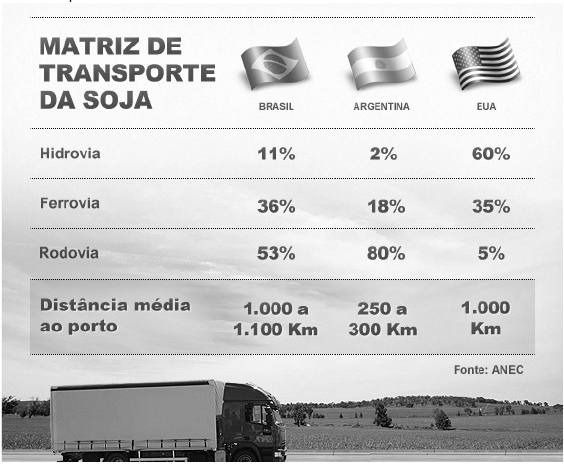
Considerando os dados acima, quanto a esses três países, é correto afirmar que
Provas
Questão presente nas seguintes provas
A sinalização de regulamentação tem por finalidade informar aos usuários as condições, obrigações, proibições e restrições do uso da via. A forma padrão é a circular e as cores são vermelha, preta e branca. O sinal de regulamentação em que não se admite acrescentar informação complementar é
Provas
Questão presente nas seguintes provas
No que se refere ao uso de smartphones como tecnologia de apoio à área secretarial, o sistema desenvolvido especificamente pela Apple para aplicação no smartphone iPhone é denominado
Provas
Questão presente nas seguintes provas
Cadernos
Caderno Container