Foram encontradas 120 questões.
A Lei Federal no 9.966/00 dispõe sobre a prevenção, o controle e a fiscalização da poluição causada por lançamento de óleo e outras substâncias nocivas ou perigosas em águas sob jurisdição nacional e dá outras providências. Na perspectiva dessa Lei, sabe-se que
Provas

A Resolução CONAMA no 23, de 07 de dezembro de 1994, instituiu procedimentos específicos para o licenciamento de atividades relacionadas à exploração e à lavra de jazidas de combustíveis líquidos e gás natural. De acordo com esta Resolução,
Provas
A Resolução CONAMA 01/86, que dispõe sobre critérios básicos e diretrizes gerais para o Relatório de Impacto Ambiental (RIMA), no artigo 6o, estabeleceu as atividades técnicas mínimas que deverão constar no Estudo de Impacto Ambiental, dentre as quais NÃO se inclui o(a)
Provas
Uma empresa que presta serviços relacionados a atividades de aquisição de dados sísmicos marítimos e em zonas de transição cometeu um erro, no que diz respeito ao licenciamento ambiental, descumprindo a Resolução CONAMA no 350, de 6 de julho de 2004, com suas retificações publicadas no DOU no 69, de 11 de abril de 2007. Essa empresa interpretou de forma INCORRETA a referida Resolução, por julgar que
Provas
A Lei nº 6.938/81, de agosto de 1981, com suas alterações dispõe sobre a Política Nacional do Meio Ambiente, seus fins e mecanismos de formulação e aplicação e dá outras providências. Sobre essa política, analise as afirmativas a seguir. ,
I – O Sistema Nacional do Meio Ambiente (SISNAMA) tem como órgão consultivo e deliberativo o Conselho Nacional do Meio Ambiente (CONAMA).
II – O zoneamento ambiental e a avaliação de impactos ambientais estão entre os instrumentos da Política Nacional do Meio Ambiente.
III – O conceito de servidão ambiental tem aplicação restrita a áreas de preservação permanente e de reserva legal.
IV – Degradação da qualidade ambiental é a alteração adversa das características do meio ambiente para as finalidades desta Lei.
Estão corretas APENAS as afirmativas
Provas
A Lei nº 9.433/97 criou o Sistema Nacional de Gerenciamento de Recursos Hídricos, definindo os seus integrantes e suas respectivas competências. Sobre estas competências, analise as afirmativas a seguir.
I – Compete à Secretaria Executiva do Conselho Nacional de Recursos Hídricos deliberar sobre os projetos de aproveitamento desses recursos, cujas repercussões extrapolem o âmbito dos estados em que serão implantados.
II – Compete às Agências de Água, no âmbito de sua área de atuação, acompanhar a administração financeira dos recursos arrecadados com a cobrança pelo uso de recursos hídricos.
III – Compete aos Comitês de Bacia Hidrográfica, no âmbito de sua área de atuação, estabelecer os mecanismos de cobrança pelo uso de recursos hídricos e sugerir os valores a serem cobrados.
IV – Compete aos Comitês de Bacia Hidrográfica, no âmbito de sua área de atuação, elaborar o Plano de Recursos Hídricos para apreciação da respectiva Agência de Água.
V – Compete ao Conselho Nacional de Recursos Hídricos aprovar propostas de instituição dos Comitês de Bacia Hidrográfica e estabelecer critérios gerais para a elaboração de seus regimentos.
Estão corretas APENAS as afirmativas
Provas
O Sistema Nacional de Unidades de Conservação (SNUC), instituído pela Lei nº 9.985, de 18 de julho de 2000, estabelece que as unidades de conservação integrantes do SNUC dividem-se em dois grupos, com características específicas: as Unidades de Proteção Integral e as Unidades de Uso Sustentável. Constituem um exemplo de unidade de proteção integral e um exemplo de unidade de uso sustentável, respectivamente,
Provas
O Brasil, como signatário da Convenção sobre Diversidade Biológica, instituiu princípios e diretrizes para a implementação da Política Nacional da Biodiversidade por meio do Decreto no 4.339, de 22 de agosto de 2002. De acordo com esse decreto, qual dos componentes abaixo NÃO faz parte da Política Nacional da Biodiversidade?
Provas
O gráfico abaixo mostra a ineficiência que é acarretada no mercado quando custos externos estão presentes. Nesse gráfico:
• BMgLP é a curva de Benefício Marginal Líquido Privado;
• CMgS e CMgP são as curvas de Custo Marginal Social e de Custo Marginal Privado;
• Pi são preços;
• Qi são quantidades;
• o ponto eficiente socialmente ocorre no ponto D, onde Ps = CMgS; e
• o ótimo social a ser produzido encontra-se em Qs.
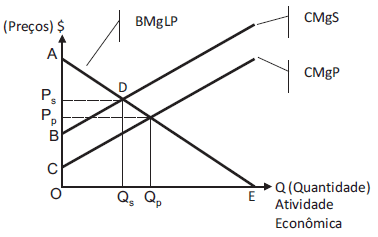
Se a externalidade não é internalizada, temos um mercado distorcido com uma quantidade consumida Qp maior que o ótimo social, pois o preço Pp é menor que o ótimo social pela não percepção por parte do mercado de seu valor ótimo. Desta forma, o Custo Marginal Externo é observado no gráfico pela
Provas
Text II
The next oil giant?
Mar 19th 2009
From the Economist Intelligence Unit ViewsWire
Financing hurdles
At the time of the Tupi discovery, oil prices were close to US$100/b, but since then they have fallen to around US$40/b. Weak prospects for a significant pickup in the medium term have raised questions about whether investors will see the project as financially viable.
The drying up of international financing, significantly lower oil prices and the technological and geological challenges related to the development of the new oil finds make long-term cost calculations difficult.
Because of this, Petrobras decided to delay the announcement of its five-year strategic plan by four months. It was finally made public in February 2008 and included very ambitious financial goals. The revised plan for 2009-13 is based on an average oil price of US$42/b and calls for investments of around US$174.4bn, a 55% increase from the US$112.4bn stated in its 2008-12 investment plan.
Petrobras has gone some way towards securing financing for this year’s outlays. The company has raised US$10.5bn of the US$28.6bn it needs. Of the remaining US$18.1bn, it is set to receive US$11.9bn from the Banco Nacional de Desenvolvimento Econômico e Social (BNDES, Brazil’s national development bank) in the form of a 30-year US$11.9bn loan, with an additional US$5bn bridge loan expected from a consortium of international banks. Petrobras would need to raise a further US$10bn to cover its investments in 2010.
Growing difficulties in accessing international capital markets could scupper these plans or—at the very least—sharply raise the cost of borrowing. The brief easing of credit conditions in January allowed Petrobras to issue a 10-year, US$1.5bn bond on the eurobond market. But low risk appetite on the part of foreign investors, recent currency-derivatives losses and continued uncertainty regarding the value of the Real mean that large Brazilian companies are increasingly likely to rely on local banks for credit at high premium spreads.
What role for private capital?
While the role of the state oil company is not in question, the level and manner of participation by the private sector is not as clear. Brazil opened its hydrocarbons sector to private investors at the end of the 1990s. Since then, it has held annual bidding rounds that have become a model of transparency and have attracted large numbers of private participants.
However, Brazil’s new oil and gas potential has raised doubts about the extent of that openness in the future, as the government debates the preferred degree of private participation. Following the Tupi discovery, the government removed 41 deepwater blocks in the sub-salt region from the ninth bidding round for the first time since it started holding international rounds in 1998.
In 2008 Brasília again withheld offshore blocks from the 10th bidding round. Seven companies currently hold concessions for the development of the sub-salt: Petrobras, BG, Galp, Repsol, Shell, Exxon and Amerada Hess.
A specially created government task force is studying possible changes to the concession laws that would give Petrobras the upper hand in the development of the Tupi area. The task force is considering options such as raising taxes and royalties on private companies producing in the new areas. Under current concession contracts, private operators sell the oil they produce in exchange for a relatively low government take of between 5% and 10%. They also pay a special participation tax of 10-40% of revenue on large fields, depending on volume, location, depth and age; this level could also be raised. A more dramatic approach under consideration is to turn concession contracts into production-sharing agreements with Petrobras. This would mean that private companies would have to share their production with the government after recovering costs.
Any changes to the current contractual agreements would need congressional approval. But the final decision will be in the hands of the president, Luiz Inácio Lula da Silva, based on the suggestions made by the task force. Whichever line he takes will set the stage for hydrocarbons developments in a future oil-rich Brazil beyond the end of his presidential term in 2010. The government hopes that by engaging in a debate early on in the development of the south-eastern oil reserves, it will pre-empt a possible shift to resource nationalism.
THE ECONOMIST
http://www.economist.com/
displaystory.cfm?story_id=13348824&source=login_payBarrier
“I am a bit apprehensive of the temptation of relegating to the background the lofty and creative initiative of Brazil in the sugar cane-based ethanol and other biofuel energy products, the moment the drilling of these huge oil wells in Tupi and its satellite oil wells takes off in earnest, amid challenging circumstances, though. My advice is that while Brazil is joyfully tinkering with the prospect of raking in colossal petro-dollar money, she shouldn’t, by any means, lose sight of the need to consolidate investment in the already standard setting, functional, renewable and clean energy source that is the ethanol. The government should find a perfect mix in due course.”
Enyinnaya wrote
Mar 21st 2009
http://www.economist.com/node/13348824/comments
The author of the comment above expresses concern for the forecast presented in Text II since
Provas
Caderno Container