Foram encontradas 70 questões.
O deslocamento de uma embarcação é 20.000 toneladas.
Um peso de 500 toneladas, localizado na linha de centro e sobre o convés principal, é retirado e colocado exatamente sob a mesma linha vertical num convés inferior. Se a distância vertical entre esses conveses mede 4 metros, a variação da posição vertical do centro de gravidade da embarcação será
Provas
Questão presente nas seguintes provas

Uma embarcação, na condição de carregamento inicial, possui deslocamento (Δ) igual a 2.550 t. Seu tanque de armazenamento de óleo combustível (γ = 0,85 t/m3) é carregado parcialmente provocando um aumento GGV do valor da posição vertical do centro de gravidade (KG).
Se esse tanque possui superfície livre retangular com comprimento igual a 15 m e largura igual a 6 m, o valor de GGV, em centímetros, é, aproximadamente,
Provas
Questão presente nas seguintes provas
Para uma embarcação que sofre uma pequena inclinação transversal (θ), são conhecidas as seguintes informações:
Deslocamento = 12.000 t
Posição vertical do centro de gravidade = 8,5 m
Posição vertical do metacentro transversal = 10,5 m
Momento de restauração = 900 t.m
Posição vertical do centro de gravidade = 8,5 m
Posição vertical do metacentro transversal = 10,5 m
Momento de restauração = 900 t.m
| Dados: | |
| θ (graus) | sen (θ) |
| 1 | 0,0175 |
| 1,5 | 0,0262 |
| 2 | 0,0349 |
| 2,5 | 0,0436 |
| 3 | 0,0523 |
| 3,5 | 0,0610 |
Nessa situação, o valor correspondente ao ângulo de inclinação transversal (θ) da embarcação, em graus, encontra-se no intervalo de
Provas
Questão presente nas seguintes provas
Considere as informações extraídas das curvas hidrostáticas de uma embarcação apresentadas na tabela abaixo.
| T | Δ | KB | BM | KM |
| 2,50 | 165,3 | 1,56 | 2,31 | 3,87 |
| 2,60 | 176,4 | 1,62 | 2,32 | 3,94 |
| 2,70 | 187,8 | 1,68 | 2,33 | 4,01 |
Onde
T = calado correspondente em metros
Δ = deslocamento em toneladas
KB = posição vertical do centro de carena em metros t
BM = raio metacêntrico transversal em metros
KM = altura metacêntrica transversal em metros
Δ = deslocamento em toneladas
KB = posição vertical do centro de carena em metros t
BM = raio metacêntrico transversal em metros
KM = altura metacêntrica transversal em metros
Sabe-se que, para a condição de carregamento correspondente ao valor de calado de 2,55 m, a posição vertical do centro de gravidade (KG) da embarcação é igual a 2,235 m.
Nessa condição, qual o valor, em metros, da altura metacêntrica transversal (GM) da embarcação?
Provas
Questão presente nas seguintes provas
De acordo com a Convenção Internacional sobre Linhas de Carga, a Linha de Carga de Inverno e a Linha de Carga de Verão para Água Doce são indicadas, respectivamente, pelas notações
Provas
Questão presente nas seguintes provas
Uma embarcação flutua, sem banda e sem trim, em água doce (γ = 1 t/m3), num calado igual a 8 m. Nessa condição, seu coeficiente de bloco (CB) é igual a 0,95, e seu deslocamento (Δ) vale 19.000 toneladas.
Para um coeficiente do plano de flutuação (CW) de 0,80, a área do plano de flutuação da embarcação, em m2, vale
Provas
Questão presente nas seguintes provas
Uma barcaça possui boca moldada igual a B e seção transversal retangular constante ao longo do seu comprimento L. Numa determinada condição de carregamento, a barcaça opera, em águas tranquilas, segundo um calado uniforme igual a T.
Para essa condição, o valor do seu raio metacêntrico transversal (BM) depende de
Provas
Questão presente nas seguintes provas
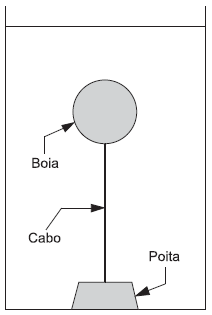
Uma boia esférica com 0,5 m3 de volume e 400 kg de massa é mantida submersa em água salgada (γ = 1,025 t/m3), utilizando-se um cabo de aço e uma poita, conforme esquematizado na figura acima.
Considerando a hipótese de que a boia, o cabo e a poita estão, perfeitamente, centralizados e alinhados verticalmente, qual o valor da força de tração, em kgf, exercida sobre o cabo?
Provas
Questão presente nas seguintes provas
Text I
A Day in the Life of the Women of O&G
by Jaime Kammerzell From Rigzone Contributor. Tuesday, February 14, 2012
Although far fewer women work in the oil and gas (O&G) industry compared to men, many women find rewarding careers in the industry. Five women were asked the same questions regarding their career choices in the oil and gas industry.
Question 1: Why did you choose the oil and gas industry?
Woman 1: Cool technology, applying science and money.
Woman 2: It seemed interesting and the pay was good.
Woman 3: They offered me a job! I couldn’t turn down the great starting salary and a chance to live in New Orleans.
Woman 4: I did not really choose the oil and gas industry as much as it chose me.
Woman 5: I chose the oil and gas industry because of the challenging projects, and I want to be part of our country’s energy solution.
Question 2: How did you get your start in the oil and gas industry?
Woman 1: I went to a university that all major oil companies recruit. I received a summer internship with Texaco before my last year of my Master’s degree.
Woman 2: I was recruited at a Texas Tech Engineering Job Fair.
Woman 3: At the time, campus recruiters came to the geosciences department of my university annually and they sponsored scholarships for graduate students to help complete their research. Even though my Master’s thesis was more geared toward environmental studies, as a recipient of one of these scholarships, my graduate advisor strongly encouraged me to participate when the time came for O&G Industry interviews.
Woman 4: I was working for a company in another state where oil and gas was not its primary business. When the company sold its division in the state where I was working, they offered me a position at the company’s headquarters in Houston managing the aftermarket sales for the company’s largest region. Aftermarket sales supported the on-highway, construction, industrial, agricultural and the oil and gas markets. After one year, the company asked me to take the position of managing their marine and offshore power products division. I held that position for three years. I left that company to join a new startup company where I hold the position of president.
Woman 5: My first job in the oil and gas industry was an internship with Mobil Oil Corp., in New Orleans.I worked with a lot of smart, focused and talented geoscientists and engineers.
Question 3: Describe your typical day.
Woman 1: Tough one to describe a typical day. I generally read email, go to a couple of meetings and work with the field’s earth model or look at seismic.
Woman 2: I talk with clients, help prepare bids and work on getting projects out the door. My days are never the same, which is what I love about the job I have.
Woman 3: I usually work from 7:30 a.m. – 6:30 p.m. (although the official day is shorter). We call the field every morning for an update on operations, security, construction, facilities and production engineering activities. I work with my team leads on short-term and long-term projects to enhance production (a lot of emails and Powerpoint). I usually have 2-3 meetings per day to discuss/prioritize/review ongoing or upcoming work (production optimization, simulation modeling, drilling plans, geologic interpretation, workovers, etc.). Beyond our team, I also participate in a number of broader business initiatives and leadership teams.
Woman 4: A typical day is a hectic day for me. My day usually starts well before 8 a.m. with phone calls and emails with our facility in Norway, as well as other business relationships abroad. At the office, I am involved in the daily business operations and also stay closely involved in the projects and the sales efforts. On any given day I am working on budgets and finance, attending project meetings, attending engineering meetings, reviewing drawings and technical specifications, meeting with clients and prospective clients, reviewing sales proposals, evaluating new business opportunities and making a lot of decisions.
Woman 5: On most days I work on my computer to complete my projects. I interpret logs, create maps, research local and regional geology or write documents. I go to project meetings almost every day. I typically work only during business hours, but there are times when I get calls at night or on weekends from a rig or other geologists for assistance with a technical problem.
Adapted from URL: <http://www.rigzone.com/news/article.asp?a_id=11508>. Retrieved on February 14, 2012. 11
Text II
How To Start A Career In The Oil And Gas Industry:
What Employers Say
By Katie Weir
From Talent Acquisition Specialist, Campus
Talisman Energy
From Talent Acquisition Specialist, Campus
Talisman Energy
How to start your career, step by step
Fix up your resumé – take it to your career centre at your university and they’ll help you.
Write a compelling cover letter that speaks to your best qualities – save the pretentious language for your English papers.
Join a professional association and attend their events – if you feel uncomfortable attending alone, try volunteering at them. By having a job to do, it gives you an excuse to interact with the attendees, and an easy way to start up a conversation the next time you see them.
Do your research – I can’t stress this enough. I want students to apply to Talisman, not because we have open jobs, but because they actually have an interest in what we’re doing, and want to be a part of it.
Be confident, but stay humble – it’s important to communicate your abilities effectively, but it’s also important to be conscious of the phrase: “sense of entitlement.” This generation entering the workforce has already been branded with the word “entitlement,” so students will need to fight against this bias from the very beginning of any relationship with people in the industry – be aware that you will need to roll up your sleeves and work hard for the first couple years, and you will be rewarded in the end.
Retrieved and adapted from URL: <http://talentegg.ca/incubator/2010/11/29/how-to-start-a-career-in-the-oil-and-gas-industry -what-employers-say/>. Acess on: February 14, 2012.
Provas
Questão presente nas seguintes provas
How To Start A Career In The Oil And Gas Industry:
What Employers Say
By Katie Weir
From Talent Acquisition Specialist, Campus
Talisman Energy
From Talent Acquisition Specialist, Campus
Talisman Energy
How to start your career, step by step
Fix up your resumé – take it to your career centre at your university and they’ll help you.
Write a compelling cover letter that speaks to your best qualities – save the pretentious language for your English papers.
Join a professional association and attend their events – if you feel uncomfortable attending alone, try volunteering at them. By having a job to do, it gives you an excuse to interact with the attendees, and an easy way to start up a conversation the next time you see them.
Do your research – I can’t stress this enough. I want students to apply to Talisman, not because we have open jobs, but because they actually have an interest in what we’re doing, and want to be a part of it.
Be confident, but stay humble – it’s important to communicate your abilities effectively, but it’s also important to be conscious of the phrase: “sense of entitlement.” This generation entering the workforce has already been branded with the word “entitlement,” so students will need to fight against this bias from the very beginning of any relationship with people in the industry – be aware that you will need to roll up your sleeves and work hard for the first couple years, and you will be rewarded in the end.
Retrieved and adapted from URL: <http://talentegg.ca/incubator/2010/11/29/how-to-start-a-career-in-the-oil-and-gas-industry -what-employers-say/>. Acess on: February 14, 2012.
The fragment that closes Text, “be aware that you will need to roll up your sleeves and work hard for the first couple years, and you will be rewarded in the end.”, implies that one must
Provas
Questão presente nas seguintes provas
Cadernos
Caderno Container