Magna Concursos

Foram encontradas 346 questões.

2439796 Ano: 2012
Disciplina: Inglês (Língua Inglesa)
Banca: CESPE / CEBRASPE
Orgão: UnB
Provas:

Caribbean festivals

Part I – Fiesta de Santiago de Apóstol in Loiza Aldea, Puerto Rico (Late July)

Nowhere is Puerto Rico’s rich West African heritage more pronounced — and celebrated — than in the coastal town of Loiza Aldea. Every July 25, the town hosts a celebration of its patron saint, Santiago, one of several Catholic saints believed to be incarnations of ancient African deities. The festival includes street parties, open-air plena and bomba concerts, and Carnival-like parades.

Part II – Festival de Merengue in Santo Domingo, Dominican Republic (Late July)

Few things are more quintessentially Dominican than “merengue”. You can hear its urgent upbeat rhythm just about anywhere you go, from supermarkets to public buses, from the capital to the countryside, and it seems Dominican children learn to dance to “merengue” almost as soon as they can walk. The annual Merengue Festival lasts less than a week and isn’t even the Dominican Republic’s largest music festival, but only Carnival makes for a bigger and more ebullient street party.

Part III – St. Patrick’s Day in Montserrat (Mid-March)

The Irish aren't the only ones who know how to throw a St. Patrick's Day party. The tiny island of Montserrat, battered by hurricanes and half-buried in volcanic ash, celebrates March 17 as a national holiday with a terrific week-long festival. St. Patrick's Day has dual importance in Montserrat: it has long been celebrated by the island's large Irish Catholic population, who first settled there in the 1630s to escape religious persecution, and it also marks the day, in 1798, that enslaved Africans launched a major uprising.

Part IV – Crop Over Festival in Barbados (July)

Why celebrate for a day or a weekend, when you can party for a whole month? That’s the attitude of Barbadians when it comes to Crop Over, the island’s largest and most anticipated festival, held from early July to early August. The celebration, which dates back to the late 1700s, originally marked the end of the all-important sugarcane harvest, when Barbados was one of the world's largest producers of sugar. Today the heart of Crop Over is calypso music, which infuses the entire event with its rhythm and lyrics.

Internet: <www.way.com> (adapted).

According to the text, it is true to infer that

“merengue” and “calypso” are prevalent in the four celebrations described in the text.


Provas

Questão presente nas seguintes provas
2440106 Ano: 2012
Disciplina: Física
Banca: CESPE / CEBRASPE
Orgão: UnB
Provas:

A condução é uma forma de transferência de energia térmica (calor). Considerando-se uma barra sólida de material condutor, a taxa de condução da energia térmica é descrita pela Lei de Fourier

!$ \Phi = -\lambda { \large \Delta T \over \Delta x} \Delta A !$,

em que !$ \Delta T !$, em Kelvin, é a diferença de temperatura entre dois pontos da barra; !$ \Delta x !$, em metros, é a distância entre os dois pontos da barra; e !$ \Delta A !$, em m2, é a área da seção reta da barra. O quociente !$ { \large \Delta T \over \Delta x} !$ e o fator de proporcionalidade !$ \lambda !$ são denominados gradiente de temperatura e condutividade térmica, respectivamente. Essa condutividade é uma propriedade do material por meio do qual a condução ocorre e seu valor pode ser determinado experimentalmente. A resistência térmica (RT) de um material é definida por

!$ R_T = \lambda^{-1} { \large \Delta T \over A} !$,

em que A é a área da seção reta. O fluxo de calor é análogo ao fluxo de carga em eletricidade. De fato, a resistência elétrica de um condutor é dada pela relação

!$ R_I = \rho { \large \Delta x \over A} !$,

em que !$ \rho !$ é a resistividade do material, A é a área da seção reta do condutor e !$ \Delta x !$ é o seu comprimento.

Considerando essas informações, julgue o item a seguir.

O fluxo !$ \Phi !$ pode ser expresso corretamente como !$ \Phi = { \large R_T \over \lambda} !$.

Questão Anulada e Desatualizada

Provas

Questão presente nas seguintes provas
2440059 Ano: 2012
Disciplina: Física
Banca: CESPE / CEBRASPE
Orgão: UnB
Provas:

Enunciado 2988329-1

A figura I, acima, apresenta gráficos representativos da absortividade de alguns gases da atmosfera e da atmosfera como um todo, enquanto a figura II representa o espectro na faixa de luz visível. Tendo como base essas figuras e considerando o número de Avogadro igual a 6 x 10²³ e a velocidade da luz igual a 3 x 10⁸ m/s, julgue o item a seguir.

Se uma molécula de O2 fosse modelada por um oscilador harmônico, ou seja, por equipamento com duas esferas ligadas por uma mola, então a absorção no comprimento de onda !$ \lambda = 0,2 \mu m !$ estaria associada a uma constante k da mola maior ou igual a 6 x 10⁴ N/m.

Questão Anulada e Desatualizada

Provas

Questão presente nas seguintes provas
2440054 Ano: 2012
Disciplina: Química
Banca: CESPE / CEBRASPE
Orgão: UnB
Provas:

Enunciado 2988324-1

A figura I, acima, apresenta gráficos representativos da absortividade de alguns gases da atmosfera e da atmosfera como um todo, enquanto a figura II representa o espectro na faixa de luz visível. Tendo como base essas figuras e considerando o número de Avogadro igual a 6 x 10²³ e a velocidade da luz igual a 3 x 10⁸ m/s, julgue o item a seguir.

Na molécula de O2, existem dois níveis de energia separados por uma diferença de energia igual a 9,945 x 10-19 J.

Questão Anulada e Desatualizada

Provas

Questão presente nas seguintes provas
2439885 Ano: 2012
Disciplina: Inglês (Língua Inglesa)
Banca: CESPE / CEBRASPE
Orgão: UnB
Provas:

Ancient origins of Halloween

Halloween’s origins date back to the ancient Celtic festival of Samhain. The Celts, who lived 2,000 years ago in the area that is now Ireland, the United Kingdom and northern France, celebrated their new year on November 1. This day marked the end of summer and the harvest and the beginning of the dark, cold winter, a time of year that was often associated with human death. Celts believed that on the night before the new year, the boundary between the worlds of the living and the dead became blurred. On the night of October 31 they celebrated Samhain, when it was believed that the ghosts of the dead returned to earth. In addition to causing trouble and damaging crops, Celts thought that the presence of the otherworldly spirits made it easier for the Druids, or Celtic priests, to make predictions about the future. To commemorate the event, Druids built huge sacred bonfires, where the people gathered to burn crops and animals as sacrifices to the Celtic deities. During the celebration, the Celts wore costumes, typically consisting of animal heads and skins, and attempted to tell each other’s fortunes.

Internet: <www.history.com> (adapted).
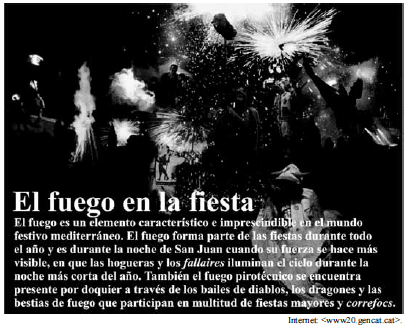
According to texts I, II and III, which celebration has religious origins?

Questão Anulada e Desatualizada

Provas

Questão presente nas seguintes provas
2439884 Ano: 2012
Disciplina: Espanhol (Língua Espanhola)
Banca: CESPE / CEBRASPE
Orgão: UnB
Provas:

Las danzas y el fuego

Si bien algunos autores dudan de que en la Península Ibérica existiesen danzas regladas con anterioridad a la venida de los romanos, lo cierto es que Estrabón nos habla de los pueblos celtas y celtíberos diciéndonos que bailaban en el plenilunio a un Dios sin nombre, y por otra parte, han llegado a nosotros, aunque algo modificadas, un gran número de danzas, la mayoría de las cuales tiene un marcado carácter religioso. Se pueden citar como ejemplo: las danzas de vísperas en Galicia, la danza prima en Asturias, la sardana en Cataluña, etc. Más tarde, al ser conquistada la Península por los romanos, el pueblo asimiló las danzas, generalmente licenciosas, que los conquistadores traían, pero manteniendo siempre las indígenas. Además de las danzas de carácter religioso, existía otro tipo de danzas muy importante de carácter guerrero, de las cuales encontramos muestras por toda la Península, aunque hubo pueblos, como los cántabros, que casi no fueron invadidos, en los que se conservaron las tradiciones de una forma más pura.

Rocío Espada. La danza española (adaptado).

Enunciado 2988154-1

Enunciado 2988154-2

Si llevamos en cuenta la viñeta arriba, así como lo expuesto en los textos I, II y III, una medida con buenas perspectivas de éxito para acabar con los problemas ligados al uso del fuego y de la pirotecnia en las festividades mediterráneas, como por ejemplo la de San Juan, es proponer

Questão Anulada e Desatualizada

Provas

Questão presente nas seguintes provas