Foram encontradas 849 questões.
A figura apresenta os perfis de TPR dos catalisadores: (A) NiO mássico, (B) 8%Ni/\( α \)-Al2O3, (C) 16%Ni/\( α \)-Al2O3, (D) 8%Ni/\( \gamma \)-Al2O3 e (E) 16%Ni/\( \gamma \)-Al2O3. Os catalisadores foram preparados por impregnação úmida a partir da solução de nitrato de níquel e calcinados a 823 K. Observe.

Diante do exposto, é correto afirmar que
Provas

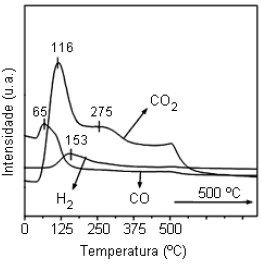
A figura apresenta os perfis de TPD de CO em catalisador Cu/CeO2, em que os produtos da dessorção (H2, CO e CO2) foram monitorados por espectrômetro de massas. Observe.
(Catálise heterogênea, M. Schmal, Ed. Synergia. 2011.)
Considerando que apenas o CO foi adsorvido,
I. a formação de CO2 pode estar associada à reação de desproporcionamento de CO.
II. a formação de CO2 pode estar associada à reação do CO com o oxigênio da rede da céria.
III. a formação simultânea de H2 e CO2 pode ser devido à reação do CO com as hidroxilas superficiais do suporte.
Está(ão) correta(s) a(s) alternativa(s)
Provas
Sabe-se que um grama de catalisador de Ir/Al2O3 que contém 2% em massa de Ir apresentou volume total de H2 adsorvido nas condições normais de temperatura e pressão de 1,15 cm3. Considere que o Ir possui densidade de átomos metálicos superficiais de 1,35 x 10¹⁹ átomos/m2. A área metálica desse catalisador, em m2/gmetal, é igual a
Provas
Em relação aos métodos de preparação de catalisadores heterogêneos, é INCORRETO afirmar que
Provas
A isoterma de Brunauer-Emmett-Teller (BET) descreve a adsorção física de vapores e permite a medida da área específica e de calores de adsorção. Sobre a isoterma BET, analise.
I. Nas hipóteses para dedução da equação BET, assume-se que cada espécie adsorvida na primeira camada serve como sítio para a adsorção da segunda camada e assim por diante, com os calores de adsorção, ou condensação sendo crescentes na ordem da camada mais interna para a mais externa.
II. A zona da validade da equação BET é restrita a uma parte da isoterma, geralmente para valores de P/P0 entre 0,05 e 0,6.
III. Quando a área específica do material é muito baixa recomenda-se a utilização de um adsorbato de maior pressão de vapor, permitindo maior precisão na determinação da isoterma.
IV. O método do ponto único para o cálculo da área específica só é válido quando o valor da constante C for superior a 500.
Está(ão) correta(s) apenas a(s) afirmativa(s)
Provas
As isotermas de adsorção/dessorção caracterizam as propriedades texturais dos materiais. As isotermas podem ser classificadas em 5 tipos clássicos que caracterizam diferentes sólidos. Uma isoterma típica é representada a seguir. Observe.
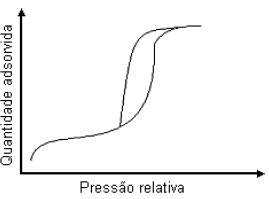
É correto afirmar que a isoterma de adsorção é do tipo
Provas
Os métodos sol-gel envolvem a formação espontânea de um material bifásico (gel), que consiste em uma rede tridimensional sólida preenchida com solvente, a partir de uma dispersão de partículas coloidais (sol). A preparação de suportes óxidos e catalisadores metálicos suportados pelo método sol-gel envolve uma série de etapas, com reações químicas e tratamentos térmicos. Assinale a alternativa que apresenta uma etapa que NÃO está envolvida num típico processo sol-gel.
Provas
As isotermas são a maneira mais conveniente para se especificar o equilíbrio da adsorção e seu tratamento teórico. Baseando-se em suposições para descrever os fenômenos químicos e físicos, é possível representar estes processos através de equações matemáticas, que relacionam o volume de adsorção em função da pressão do gás. Tais equações são ferramentas importantes para o entendimento dos mecanismos reacionais no campo da catálise heterogênea. Vários estudos foram desenvolvidos no campo da adsorção com o surgimento de diferentes modelos. O campo de adsorção aplicado corretamente nos Isotermas de Langmuir, Temkin, Freundlich, Brunauer- Emmett-Teller são, respectivamente
Provas
Nasa successfully tests hypersonic heat shield
July 25, 2012.
The development of a large inflatable heat shield by the Space Technology Program at NASA has a number of implications for the oft-criticized space agency, as successful tests of the technology have led to speculation about its potential to support long-distance travel.
Science Daily reported that the Inflatable Reentry Vehicle Experiment (IRVE-3) was launched from NASA's Wallops Flight Facility on Wallops Island, Virginia. The heat shield reached speeds up to 7,600 miles per hour, successfully, and travelled at this rate for a significant period during the test.
The purpose of the test was to show that a space capsule can rely upon the heat shield to protect itself as it enters an atmosphere, according to the news outlet. Planetary entry and descent, including both a return to Earth from the International Space Station and any prospective missions to Mars, were targeted as potential uses for the outer shell.
“It's great to see the initial results indicate we had a successful test of the hypersonic inflatable aerodynamic decelerator”, James Reuther, deputy director of NASA's Space Technology Program, said in a statement. “This demonstration flight goes a long way toward showing the value of these technologies to serve as atmospheric entry heat shields for future space.”
NASA's engineering research team used a cone of uninflated high-tech rings covered by a thermal blanket of layers of heat resistant materials for IRVE-3, as the heat shield was launched for its suborbital flight from a three-stage Black Brant Rocket, according to Science Daily.
The heat shield was inflated by a system that pumped nitrogen into the aero shell until it expanded to a shape with a diameter of 10 feet. Engineers at the Wallops site monitored IRVE-3 by watching four onboard cameras and onboard instruments, as the temperature and pressure levels of the craft were closely observed to ensure the success of the test.
From takeoff to splashdown, the flight lasted roughly 20 minutes, but the implications of the test could have a far-reaching impact on NASA's ability to support space travel.
“A team of NASA engineers and technicians spent the last three years preparing for the IRVE-3 flight,” said Lesa Roe, director of NASA's Langley Research Center in Hampton, Va. “We are pushing the boundaries with this flight. We look forward to future test launches of even bigger inflatable aero shells.”
Space.com reported that NASA engineers want this test to serve as a springboard for later efforts, including the use of these heat shields for larger payloads, such as ships that contain large amounts of materials or even human passengers.
“We want to go to higher latitudes at that mass, or use this technology for larger payloads, such as humans”, Neal Cheatwood, the principal engineer for the test, told the news outlet
Cheatwood noted that the engineering research team is trying to outline the myriad potential uses for the heat shield, but the first application is likely to be a support role for the removal of garbage for the International Space Station.
Robotic spacecraft are sent to remove trash from the ISS, but can only carry a small amount of supplies on these trips. However, the successful IRVE-3 test showed that there is a potential for the heat shield to increase the productivity of these trips.
“When we send up re-supply [spacecraft] to the station, there's no portable on-demand storage up there,” Cheatwood told Space.com. “When they bring up 'x' number of cubic feet of stuff, we need to get rid of that much as well.”
(http://why.knovel.com/all-engineering-news/1746-nasa-successfully-tests-hypersonic-heat-shield.html – Com adaptações.)
The utterance by Neal Cheatwood “We want to go to higher latitudes at that mass, or use this technology for larger payloads, such as humans” in the indirect speech is
Provas
Nasa successfully tests hypersonic heat shield
July 25, 2012.
The development of a large inflatable heat shield by the Space Technology Program at NASA has a number of implications for the oft-criticized space agency, as successful tests of the technology have led to speculation about its potential to support long-distance travel.
Science Daily reported that the Inflatable Reentry Vehicle Experiment (IRVE-3) was launched from NASA's Wallops Flight Facility on Wallops Island, Virginia. The heat shield reached speeds up to 7,600 miles per hour, successfully, and travelled at this rate for a significant period during the test.
The purpose of the test was to show that a space capsule can rely upon the heat shield to protect itself as it enters an atmosphere, according to the news outlet. Planetary entry and descent, including both a return to Earth from the International Space Station and any prospective missions to Mars, were targeted as potential uses for the outer shell.
“It's great to see the initial results indicate we had a successful test of the hypersonic inflatable aerodynamic decelerator”, James Reuther, deputy director of NASA's Space Technology Program, said in a statement. “This demonstration flight goes a long way toward showing the value of these technologies to serve as atmospheric entry heat shields for future space.”
NASA's engineering research team used a cone of uninflated high-tech rings covered by a thermal blanket of layers of heat resistant materials for IRVE-3, as the heat shield was launched for its suborbital flight from a three-stage Black Brant Rocket, according to Science Daily.
The heat shield was inflated by a system that pumped nitrogen into the aero shell until it expanded to a shape with a diameter of 10 feet. Engineers at the Wallops site monitored IRVE-3 by watching four onboard cameras and onboard instruments, as the temperature and pressure levels of the craft were closely observed to ensure the success of the test.
From takeoff to splashdown, the flight lasted roughly 20 minutes, but the implications of the test could have a far-reaching impact on NASA's ability to support space travel.
“A team of NASA engineers and technicians spent the last three years preparing for the IRVE-3 flight,” said Lesa Roe, director of NASA's Langley Research Center in Hampton, Va. “We are pushing the boundaries with this flight. We look forward to future test launches of even bigger inflatable aero shells.”
Space.com reported that NASA engineers want this test to serve as a springboard for later efforts, including the use of these heat shields for larger payloads, such as ships that contain large amounts of materials or even human passengers.
“We want to go to higher latitudes at that mass, or use this technology for larger payloads, such as humans”, Neal Cheatwood, the principal engineer for the test, told the news outlet
Cheatwood noted that the engineering research team is trying to outline the myriad potential uses for the heat shield, but the first application is likely to be a support role for the removal of garbage for the International Space Station.
Robotic spacecraft are sent to remove trash from the ISS, but can only carry a small amount of supplies on these trips. However, the successful IRVE-3 test showed that there is a potential for the heat shield to increase the productivity of these trips.
“When we send up re-supply [spacecraft] to the station, there's no portable on-demand storage up there,” Cheatwood told Space.com. “When they bring up 'x' number of cubic feet of stuff, we need to get rid of that much as well.”
(http://why.knovel.com/all-engineering-news/1746-nasa-successfully-tests-hypersonic-heat-shield.html – Com adaptações.)
The word highlighted in “The purpose of the test was to show that a space capsule can rely upon the heat shield to protect itself as it enters an atmosphere,…” can be substituted, with no change of meaning, for
Provas
Caderno Container