Foram encontradas 251 questões.
Quando estudamos a mídia, a comunicação e as tecnologias na educação percebemos o quanto o trabalho com as mídias em sala de aula pode proporcionar novas formas de comunicação, habilidades, competências e linguagens relacionadas à sociedade contemporânea.
Nesse sentido, o autor Moran (2007) destaca que:
Provas

Com base no estudo da interpretação consecutiva, a Teoria do Sentido consiste, resumidamente, em memorizar o sentido do que foi dito sem supervalorizar a memorização das palavras com que esse sentido foi expresso.
A esse processo, a Teoria do Sentido refere-se à(ao):
Provas
Analise o parágrafo abaixo sobre o tema “Teorias de aquisição da linguagem”.
“De acordo com Skinner, o aprendizado da linguagem é sustentado como sendo um comportamento ................ , de múltiplas causas, que se desenvolveria por intermédio ................ advindos do ................ sobre a conduta da criança e desta sobre aquele.”
Assinale a alternativa que completa corretamente as lacunas do texto.
Provas
Charity begins at home
In the past month, have you donated money to an organization? Have you volunteered time to a charitable organization? Have you helped a stranger, or someone you don’t know who needed help?
These are the three questions that were asked in a survey of charitable behaviour .............. the world, organized .............. the Charities Aid Foundation (CAF). The results of the survey were published .............. the beginning of September. They revealed that 20% of the world’s population had volunteered time .............. the previous month, 30% had given money .............. charity, and 45% had helped a stranger.
The survey was based on data collected from 153 countries representing around 95% of the world’s population. In most of the countries, 1,000 questionnaires were completed by a representative sample of the population aged 16 or over. CAF created a ‘World Giving Index’ to find out which countries were the most charitable. Australia and New Zealand turned out to be the most ‘giving’ countries in the world, followed by Canada, Ireland, Switzerland and the USA.
Although rich countries were at the top of the list, around half of the top 20 places were occupied by developing nations including Guinea and Turkmenistan.
The data also showed that as we get older, we are more likely to give. In most countries, people over 50 are least likely to help a stranger. Men are more likely to help a stranger than women and more likely to volunteer. Women, however, are slightly more likely than men to give money (30% versus 29%).
The interviewees were also asked to imagine a ladder with steps numbered from 0 at the bottom to 10 at the top, with 0 representing the worst possible life and 10 the best. They were then asked to place themselves on the step of the ladder that reflected the way they felt about their life at the moment.
The results showed that the link between the giving of money and happiness is stronger than the link between giving and wealth. This means that a person is more likely to give to charity if they live in a country where people are generally happy, than if they live in an affluent country. And, of course, giving can make us even happier.
Check the alternative that correctly completes the sentences gaps below in the order they appear.
- “................ begins at home” is a saying that means you should look after yourself and your own family before helping other people.
- If you do ................ work then you are helping other people.
- When you give money to a charity, you ................ it.
- If you ................ to do some work then you don’t expect to get paid
Provas
Um aquecedor esquenta em 1,5 graus a temperatura ambiente de um quarto a cada 28 minutos.
Se a temperatura atual é 14 graus, quanto tempo levará para a temperatura chegar a 26 graus?
Provas
Em um hospital, o paciente A deve ser visitado por uma enfermeira a cada 84 minutos e o paciente B a cada 90 minutos.
Se ambos são visitados por uma enfermeira neste instante, em quantos minutos eles voltarão a ser visitados simultaneamente?
Provas
Nas sentenças “Eu quero aprender Libras” e “Eu não quero aprender Libras”, o verbo “querer” na sua forma afirmativa e negativa é sinalizado:
Provas
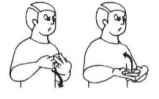
Observe a ilustração ao lado de Capovilla & Raphael (2001), e assinale a alternativa que traduz corretamente o sentido para o Português:
Provas
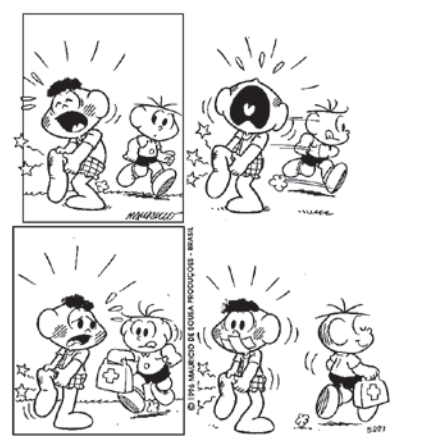
Observe a tirinha abaixo do Cascão e Cebolinha.
Copyright © 1999 Muricio de Souza Produções Ltda. Todos os direitos reservados. 5221
Em situação de tradução dos eventos quadro a quadro, o sinal de “gritar” com diferentes intensidades, ao ser sinalizado em Libras, é realizado com a mesma CM e:
Provas
Assinale a alternativa com as palavras em português, que ao serem sinalizadas em Libras, são consideradas sinais homônimos
Provas
Caderno Container