Foram encontradas 70 questões.
Considere que um reagente R deve ser alimentado puro a um reator, onde ocorre unicamente a reação R → P, sendo o efluente do reator alimentado a um sistema de separação no qual a separação entre reagente e produto é total, conforme a figura abaixo.

A tabela a seguir apresenta a capacidade de processamento do reator em função da vazão de reagente alimentado.

Uma função empírica para o custo de separação, fornecida em função das vazões de R e P alimentadas no separador, tem a forma C($/h) = 0,2(FR+FP), onde FR e FP são dados em kg/h. Por sua vez, o lucro obtido com P produzido é dado por L($/h) = FP.
Observando o que foi exposto, a condição apresentada na tabela que fornece maior valor para L − C é
Provas

Sobre a resolução de balanços materiais e energéticos em fluxogramas de processo, considere as afirmações a seguir.
I - Em quase todos os casos práticos, a presença de reciclos dificulta significativamente o fechamento de balanços materiais e energéticos gerais e associados às equações dos equipamentos; ainda assim, apenas em poucos casos, há realmente necessidade de uso de métodos numéricos e recursos computacionais.
II - A estratégia modular, empregada em diversos simuladores, consiste em elaborar um grande conjunto de equações envolvendo todos os equipamentos, e tentar resolver tal conjunto de equações simultaneamente.
III - Segundo a estratégia modular, as variáveis associadas às correntes de reciclos tipicamente são variáveis de abertura, para as quais se devem admitir estimativas iniciais de forma a permitir a resolução das equações dos equipamentos; procedimento esse que irá fornecer novas estimativas para as variáveis das correntes de reciclos, e que, quando há convergência, é interrompido.
Está correto APENAS o que se afirma em
Provas
Uma corrente líquida contendo um composto orgânico com vazão de 25.000 kg/h é parcialmente vaporizada em um refervedor, sendo o calor de vaporização do orgânico Δhvap≈ 350 kJ.kg−1. O calor é fornecido por 2.000 kg.h−1 de vapor de água saturado que se condensa totalmente, conforme ilustrado na figura a seguir.
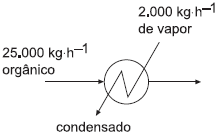
Admita que os processos de mudança de fase ocorram isotermicamente, que a pressão manométrica de entrada do vapor é 4 atm e que a temperatura de vapor é 20 °C superior à temperatura do orgânico. Nessas condições, os valores aproximados da vazão vaporizada do composto orgânico e da temperatura de saída do orgânico são, respectivamente,
Provas
Se, em um dia em Florianópolis a 18 °C, a umidade relativa do ar é igual a 50%, então, a umidade absoluta em gramas de água por quilogramas de ar seco é, aproximadamente, igual a
Dados
Massa molar da água = 18 g/mol
Massa molar do ar = 29 g/mol
Provas
Para a obtenção de zinco metálico por eletrólise, faz-se necessária a obtenção de solução de zincato de sódio a partir de óxido de zinco, conforme reação a seguir.
ZnO + 2NaOH → Na2ZnO2 + H2O
Se 3.000 toneladas de um minério contendo 25% de ZnO em massa devem ser tratadas, aproximadamente quantas toneladas de uma solução contendo NaOH 50% (m/m) devem ser empregadas?
Dados
Massa atômica do Zn = 65
Massa atômica do Na = 23
Massa atômica do O = 16
Massa atômica do H = 1
Provas
No reservatório de uma fábrica de polipropileno são armazenados 300 kmol de propileno submetido à pressão de 5 atm e temperatura de 0 °C.
Se o reservatório estivesse submetido à pressão atmosférica e na mesma condição de temperatura, quais seriam o volume e a massa de propeno nele armazenados?
Dados
Massa atômica do C = 12
Massa atômica do H = 1
1 mol de gás ideal a 0 °C e 1atm ocupa 22,4L
Provas
Em um béquer, prepara-se uma solução contendo 360 g de água, 184 g de etanol e 120 g de fosfato monobásico de sódio (NaH2(PO4)).
A fração molar de NaH2(PO4) nessa solução é igual a
Dados
Massa molar do etanol = 46 g/mol
Massa molar da água = 18 g/mol
Massa molar do NaH2(PO4) = 120 g/mol
Provas
Some of you may be familiar with OSHA - the Occupational Safety & Health Administration. The sole purpose of this agency is to keep American workers safe. Complying with OSHA regulations isn't always easy, but if we work together, we can do it. Yet, complying with regulations is not the real reason for working safely. Our real motive is simple. We care about each and every one of you and will do what is necessary to prevent you from being injured.
However, keeping our workplace safe takes input from everyone. Management, supervisor, and all of you have to come together on this issue, or we're in trouble. For example, upper management has to approve the purchase of safe equipment. Supervisors, including myself, have to ensure that each of you knows how to use that equipment safely. Then it's up to you to follow through the task and use the equipment as you were trained. If any one part of this chain fails, accidents are going to happen and people are going to get hurt.
Responsibility Number One - Recognize Hazards
At the core of your safety responsibilities lies the task of recognizing safety and health hazards. In order to do that, you must first understand what constitutes a hazard. Extreme hazards are often obvious. Our hopes are that you won't find too many of those around here.
There are, however, more subtle hazards that won't jump up and bite you. As a result of your safety training and meetings like these, some things may come to mind. For example, a machine may not be easy to lock out. Common practice may be to use a tag. This is a potential hazard and should be discussed. Maybe something can be changed to make it easier to use a lock. Other subtle hazards include such things as frayed electrical cords, a loose machine guard, a cluttered aisle, or maybe something that just doesn't look right.
Responsibility Number Two - Report Hazards
A big part of recognizing hazards is using your instincts. Nobody knows your job as well as you do, so we're counting on you to let us know about possible problems. Beyond recognizing hazards, you have to correct them or report them to someone who can. This too, is a judgement call. For example, if something spills in your work area you can probably clean it up yourself. However, if there is an unlabeled chemical container and you have no idea what it is, you should report it to your supervisor.
Additional Employee Responsibilities
Good housekeeping is a major part of keeping your work area safe. For example, you should take a few minutes each day to ensure that aisles, hallways, and stairways in your work area are not obstructed. If boxes, equipment, or anything else is left to pile up, you have a tripping hazard on your hands. Those obstructions could keep you from exiting the building quickly and safely should you face an emergency situation.
Also watch out for spills. These can lead to slips and falls. Flammable materials are another thing to be aware of. Make sure they are disposed of properly.
Keep Thinking. Even if you're doing your job safely and you are avoiding hazards, there are often even better ways to work safely. If you have ideas for improving the safety of your job or that of co-workers, share them.
Concluding Remarks
While nothing we do can completely eliminate the threat of an incident, we can work together to improve our odds. As I said, this must be a real team effort and I'm counting on input from all of you. Let's keep communicating and continue to improve safety.
Available at: <http://www.ncsu.edu/ehs/www99/right/training/meeting/emplores.html>.Retrieved on: April 1st, 2012. Adapted.
Provas
Some of you may be familiar with OSHA - the Occupational Safety & Health Administration. The sole purpose of this agency is to keep American workers safe. Complying with OSHA regulations isn't always easy, but if we work together, we can do it. Yet, complying with regulations is not the real reason for working safely. Our real motive is simple. We care about each and every one of you and will do what is necessary to prevent you from being injured.
However, keeping our workplace safe takes input from everyone. Management, supervisor, and all of you have to come together on this issue, or we're in trouble. For example, upper management has to approve the purchase of safe equipment. Supervisors, including myself, have to ensure that each of you knows how to use that equipment safely. Then it's up to you to follow through the task and use the equipment as you were trained. If any one part of this chain fails, accidents are going to happen and people are going to get hurt.
Responsibility Number One - Recognize Hazards
At the core of your safety responsibilities lies the task of recognizing safety and health hazards. In order to do that, you must first understand what constitutes a hazard. Extreme hazards are often obvious. Our hopes are that you won't find too many of those around here.
There are, however, more subtle hazards that won't jump up and bite you. As a result of your safety training and meetings like these, some things may come to mind. For example, a machine may not be easy to lock out. Common practice may be to use a tag. This is a potential hazard and should be discussed. Maybe something can be changed to make it easier to use a lock. Other subtle hazards include such things as frayed electrical cords, a loose machine guard, a cluttered aisle, or maybe something that just doesn't look right.
Responsibility Number Two - Report Hazards
A big part of recognizing hazards is using your instincts. Nobody knows your job as well as you do, so we're counting on you to let us know about possible problems. Beyond recognizing hazards, you have to correct them or report them to someone who can. This too, is a judgement call. For example, if something spills in your work area you can probably clean it up yourself. However, if there is an unlabeled chemical container and you have no idea what it is, you should report it to your supervisor.
Additional Employee Responsibilities
Good housekeeping is a major part of keeping your work area safe. For example, you should take a few minutes each day to ensure that aisles, hallways, and stairways in your work area are not obstructed. If boxes, equipment, or anything else is left to pile up, you have a tripping hazard on your hands. Those obstructions could keep you from exiting the building quickly and safely should you face an emergency situation.
Also watch out for spills. These can lead to slips and falls. Flammable materials are another thing to be aware of. Make sure they are disposed of properly.
Keep Thinking. Even if you're doing your job safely and you are avoiding hazards, there are often even better ways to work safely. If you have ideas for improving the safety of your job or that of co-workers, share them.
Concluding Remarks
While nothing we do can completely eliminate the threat of an incident, we can work together to improve our odds. As I said, this must be a real team effort and I'm counting on input from all of you. Let's keep communicating and continue to improve safety.
Available at: <http://www.ncsu.edu/ehs/www99/right/training/meeting/emplores.html>.Retrieved on: April 1st, 2012. Adapted.
Provas
- Vocabulário | Vocabulary
- Sinônimos | Synonyms
- Gramática - Língua InglesaAdjetivos | AdjectivesOposto | Opposite
Some of you may be familiar with OSHA - the Occupational Safety & Health Administration. The sole purpose of this agency is to keep American workers safe. Complying with OSHA regulations isn't always easy, but if we work together, we can do it. Yet, complying with regulations is not the real reason for working safely. Our real motive is simple. We care about each and every one of you and will do what is necessary to prevent you from being injured.
However, keeping our workplace safe takes input from everyone. Management, supervisor, and all of you have to come together on this issue, or we're in trouble. For example, upper management has to approve the purchase of safe equipment. Supervisors, including myself, have to ensure that each of you knows how to use that equipment safely. Then it's up to you to follow through the task and use the equipment as you were trained. If any one part of this chain fails, accidents are going to happen and people are going to get hurt.
Responsibility Number One - Recognize Hazards
At the core of your safety responsibilities lies the task of recognizing safety and health hazards. In order to do that, you must first understand what constitutes a hazard. Extreme hazards are often obvious. Our hopes are that you won't find too many of those around here.
There are, however, more subtle hazards that won't jump up and bite you. As a result of your safety training and meetings like these, some things may come to mind. For example, a machine may not be easy to lock out. Common practice may be to use a tag. This is a potential hazard and should be discussed. Maybe something can be changed to make it easier to use a lock. Other subtle hazards include such things as frayed electrical cords, a loose machine guard, a cluttered aisle, or maybe something that just doesn't look right.
Responsibility Number Two - Report Hazards
A big part of recognizing hazards is using your instincts. Nobody knows your job as well as you do, so we're counting on you to let us know about possible problems. Beyond recognizing hazards, you have to correct them or report them to someone who can. This too, is a judgement call. For example, if something spills in your work area you can probably clean it up yourself. However, if there is an unlabeled chemical container and you have no idea what it is, you should report it to your supervisor.
Additional Employee Responsibilities
Good housekeeping is a major part of keeping your work area safe. For example, you should take a few minutes each day to ensure that aisles, hallways, and stairways in your work area are not obstructed. If boxes, equipment, or anything else is left to pile up, you have a tripping hazard on your hands. Those obstructions could keep you from exiting the building quickly and safely should you face an emergency situation.
Also watch out for spills. These can lead to slips and falls. Flammable materials are another thing to be aware of. Make sure they are disposed of properly.
Keep Thinking. Even if you're doing your job safely and you are avoiding hazards, there are often even better ways to work safely. If you have ideas for improving the safety of your job or that of co-workers, share them.
Concluding Remarks
While nothing we do can completely eliminate the threat of an incident, we can work together to improve our odds. As I said, this must be a real team effort and I'm counting on input from all of you. Let's keep communicating and continue to improve safety.
Available at: <http://www.ncsu.edu/ehs/www99/right/training/meeting/emplores.html>.Retrieved on: April 1st, 2012. Adapted.
Provas
Caderno Container