Foram encontradas 70 questões.
Observe a charge a seguir e analise as afirmações
apresentadas:
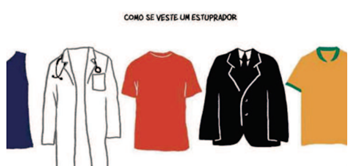
Folha de São Paulo
I. Porque médicos e demais profissionais da saúde podem cometer atos de violência sexual, é garantido à mulher que se submete a exames e procedimentos, estar acompanhada por alguém de sua confiança.
II. Têm havido, recentemente, acusações de estupro contra jogadores profissionais que atuaram na seleção brasileira de futebol.
III. Apenas homens com roupas simples, como regatas e camisetas, são potenciais autores de violência sexual contra mulheres.
De acordo com as ideias contidas na charge, estão corretas as afirmações contidas em
Folha de São Paulo
I. Porque médicos e demais profissionais da saúde podem cometer atos de violência sexual, é garantido à mulher que se submete a exames e procedimentos, estar acompanhada por alguém de sua confiança.
II. Têm havido, recentemente, acusações de estupro contra jogadores profissionais que atuaram na seleção brasileira de futebol.
III. Apenas homens com roupas simples, como regatas e camisetas, são potenciais autores de violência sexual contra mulheres.
De acordo com as ideias contidas na charge, estão corretas as afirmações contidas em
Provas
Questão presente nas seguintes provas

Have you ever taken the time to craft a detailed email to a
colleague, or perhaps a text message to a friend, only to have
them shoot back a one-line response that makes it clear they
didn’t read past the first sentence?
The Gazette interviewed Todd Rogers, a behavioural scientist, about his book, “Writing for Busy Readers: Communicate More Effectively in the Real World”.
Gazette: You make a distinction between “effective writing” and “beautiful writing.” What do you mean by effective writing?
Rogers: Effective writing is practical writing with the goal of getting the reader to understand and potentially respond. The guiding insight for the book is that our readers are not reading what we write carefully.
Gazette: You discuss experiments that support strategies for simplifying writing. Could you summarize a few of those tips?
Rogers: First: Less is more: fewer words, fewer ideas, fewer requests. Omit needless words, so that’s not radical, and it’s costless. Eliminating somewhat-useful-but-not-necessary ideas is harder. It’s a balance between getting the point across and adding too much. Finally, the more actions a message asks of readers, the less likely readers are to do any one of them. Second: Add structure. Most people aren’t reading linearly; they’re jumping around.
Third: Use enough formatting, but no more. We found that people interpret underline, bold, and highlight as the writer saying to the reader, “this is the most important content.” When writers highlight or bold a section in a document or an email, it dramatically increases the likelihood that people read that portion, but it decreases the likelihood that they read the rest of the message.
https://news.harvard.edu/gazette/story/2023/10/tips-on-how-to-connectwith-people-who-dont-have-time-to-read. Acesso em: 23/02/2024.
Segundo o texto, uma dificuldade apontada por Todd Rogers, no que diz respeito à simplificação da escrita, refere-se a
The Gazette interviewed Todd Rogers, a behavioural scientist, about his book, “Writing for Busy Readers: Communicate More Effectively in the Real World”.
Gazette: You make a distinction between “effective writing” and “beautiful writing.” What do you mean by effective writing?
Rogers: Effective writing is practical writing with the goal of getting the reader to understand and potentially respond. The guiding insight for the book is that our readers are not reading what we write carefully.
Gazette: You discuss experiments that support strategies for simplifying writing. Could you summarize a few of those tips?
Rogers: First: Less is more: fewer words, fewer ideas, fewer requests. Omit needless words, so that’s not radical, and it’s costless. Eliminating somewhat-useful-but-not-necessary ideas is harder. It’s a balance between getting the point across and adding too much. Finally, the more actions a message asks of readers, the less likely readers are to do any one of them. Second: Add structure. Most people aren’t reading linearly; they’re jumping around.
Third: Use enough formatting, but no more. We found that people interpret underline, bold, and highlight as the writer saying to the reader, “this is the most important content.” When writers highlight or bold a section in a document or an email, it dramatically increases the likelihood that people read that portion, but it decreases the likelihood that they read the rest of the message.
https://news.harvard.edu/gazette/story/2023/10/tips-on-how-to-connectwith-people-who-dont-have-time-to-read. Acesso em: 23/02/2024.
Segundo o texto, uma dificuldade apontada por Todd Rogers, no que diz respeito à simplificação da escrita, refere-se a
Provas
Questão presente nas seguintes provas
Ethical codes evolve in response to changing conditions,
values, and ideas. A professional code of ethics must,
therefore, be periodically updated, and also rest upon widely
shared values.
Although the operating environment of museums grows
more complex each year, the root value for museums, the tie
that connects all of us together despite our diversity, is the
commitment to serving people, both present and future
generations.
Historically, museums have owned and used natural
objects, living and non-living, and all manner of human
artifacts to advance knowledge and nourish the human spirit.
Today, the range of their special interests reflects the
scope of human vision. Their missions include collecting and
preserving, as well as exhibiting and educating with materials
not only owned but also borrowed and fabricated for these
ends. Their numbers include both governmental and private
museums.
The museum universe in the United States includes both
collecting and noncollecting institutions. Although diverse in
their missions, they have in common their nonprofit form of
organization and a commitment of service to the public. Their
collections and/or the objects they borrow or fabricate are the
basis for research, exhibits, and programs that invite public
participation.
Taken as a whole, museum collections and exhibition
materials represent the world's natural and cultural common
wealth. As stewards of that wealth, museums are compelled
to advance an understanding of all natural forms and of the
human experience. It is incumbent on museums to be
resources for humankind and in all their activities to foster an
informed appreciation of the rich and diverse world we have
inherited. It is also incumbent upon them to preserve that
inheritance for posterity.
www.aam-us.org/museumresources/ethics/coe.cfm. Acessado em
22/02/2024. Adaptado.
Provas
Questão presente nas seguintes provas
Ethical codes evolve in response to changing conditions,
values, and ideas. A professional code of ethics must,
therefore, be periodically updated, and also rest upon widely
shared values.
Although the operating environment of museums grows
more complex each year, the root value for museums, the tie
that connects all of us together despite our diversity, is the
commitment to serving people, both present and future
generations.
Historically, museums have owned and used natural
objects, living and non-living, and all manner of human
artifacts to advance knowledge and nourish the human spirit.
Today, the range of their special interests reflects the
scope of human vision. Their missions include collecting and
preserving, as well as exhibiting and educating with materials
not only owned but also borrowed and fabricated for these
ends. Their numbers include both governmental and private
museums.
The museum universe in the United States includes both
collecting and noncollecting institutions. Although diverse in
their missions, they have in common their nonprofit form of
organization and a commitment of service to the public. Their
collections and/or the objects they borrow or fabricate are the
basis for research, exhibits, and programs that invite public
participation.
Taken as a whole, museum collections and exhibition
materials represent the world's natural and cultural common
wealth. As stewards of that wealth, museums are compelled
to advance an understanding of all natural forms and of the
human experience. It is incumbent on museums to be
resources for humankind and in all their activities to foster an
informed appreciation of the rich and diverse world we have
inherited. It is also incumbent upon them to preserve that
inheritance for posterity.
www.aam-us.org/museumresources/ethics/coe.cfm. Acessado em
22/02/2024. Adaptado.
Provas
Questão presente nas seguintes provas
Ethical codes evolve in response to changing conditions,
values, and ideas. A professional code of ethics must,
therefore, be periodically updated, and also rest upon widely
shared values.
Although the operating environment of museums grows
more complex each year, the root value for museums, the tie
that connects all of us together despite our diversity, is the
commitment to serving people, both present and future
generations.
Historically, museums have owned and used natural
objects, living and non-living, and all manner of human
artifacts to advance knowledge and nourish the human spirit.
Today, the range of their special interests reflects the
scope of human vision. Their missions include collecting and
preserving, as well as exhibiting and educating with materials
not only owned but also borrowed and fabricated for these
ends. Their numbers include both governmental and private
museums.
The museum universe in the United States includes both
collecting and noncollecting institutions. Although diverse in
their missions, they have in common their nonprofit form of
organization and a commitment of service to the public. Their
collections and/or the objects they borrow or fabricate are the
basis for research, exhibits, and programs that invite public
participation.
Taken as a whole, museum collections and exhibition
materials represent the world's natural and cultural common
wealth. As stewards of that wealth, museums are compelled
to advance an understanding of all natural forms and of the
human experience. It is incumbent on museums to be
resources for humankind and in all their activities to foster an
informed appreciation of the rich and diverse world we have
inherited. It is also incumbent upon them to preserve that
inheritance for posterity.
www.aam-us.org/museumresources/ethics/coe.cfm. Acessado em
22/02/2024. Adaptado.
Provas
Questão presente nas seguintes provas
Among my fellow punctuation nerds, I have a
reputation as someone who does not see any use for
semicolons. Cecelia Watson, who teaches at Bard College, has
written a whole book about them: “Semicolon: The Past,
Present, and Future of a Misunderstood Mark.”
Watson, a historian and philosopher of science and a
teacher of writing and the humanities—in other words, a
Renaissance woman—gives us a deceptively playful-looking
book that turns out to be a scholarly treatise on a
sophisticated device that has contributed eloquence and
mystery to Western civilization.
The semicolon itself was a Renaissance invention. It
first appeared in 1494, in a book published in Venice by Aldus
Manutius. “De Aetna,” Watson explains, was “an essay,
written in dialogue form,” about climbing Mt. Etna. The mark
was a hybrid between a comma and a colon, and its purpose
was to prolong a pause or create a more distinct separation
between parts of a sentence.
The problem with the semicolon is not how it looks but
what it does and how that has changed over time. In the old
days, punctuation simply indicated a pause. Comma, colon:
semicolon; period. Eventually, grammarians and copy editors
came along and made themselves indispensable by
punctuating (“pointing”) a writer’s prose “to delineate clauses
properly, such that punctuation served syntax.” That is,
commas, semicolons, and colons were included in a sentence
in order to highlight, subordinate, or otherwise conduct its
elements, connecting them syntactically. One of the rules is
that, unless you are composing a list, a semicolon is supposed
to be followed by a complete clause, capable of standing on
its own. The semicolon can take the place of a conjunction,
like “and” or “but,” but it should not be used in addition to it.
https://www.newyorker.com/culture/comma-queen/sympathy-for-thesemicolon. July 15, 2019. Adaptado.
Provas
Questão presente nas seguintes provas
Among my fellow punctuation nerds, I have a
reputation as someone who does not see any use for
semicolons. Cecelia Watson, who teaches at Bard College, has
written a whole book about them: “Semicolon: The Past,
Present, and Future of a Misunderstood Mark.”
Watson, a historian and philosopher of science and a
teacher of writing and the humanities—in other words, a
Renaissance woman—gives us a deceptively playful-looking
book that turns out to be a scholarly treatise on a
sophisticated device that has contributed eloquence and
mystery to Western civilization.
The semicolon itself was a Renaissance invention. It
first appeared in 1494, in a book published in Venice by Aldus
Manutius. “De Aetna,” Watson explains, was “an essay,
written in dialogue form,” about climbing Mt. Etna. The mark
was a hybrid between a comma and a colon, and its purpose
was to prolong a pause or create a more distinct separation
between parts of a sentence.
The problem with the semicolon is not how it looks but
what it does and how that has changed over time. In the old
days, punctuation simply indicated a pause. Comma, colon:
semicolon; period. Eventually, grammarians and copy editors
came along and made themselves indispensable by
punctuating (“pointing”) a writer’s prose “to delineate clauses
properly, such that punctuation served syntax.” That is,
commas, semicolons, and colons were included in a sentence
in order to highlight, subordinate, or otherwise conduct its
elements, connecting them syntactically. One of the rules is
that, unless you are composing a list, a semicolon is supposed
to be followed by a complete clause, capable of standing on
its own. The semicolon can take the place of a conjunction,
like “and” or “but,” but it should not be used in addition to it.
https://www.newyorker.com/culture/comma-queen/sympathy-for-thesemicolon. July 15, 2019. Adaptado.
Provas
Questão presente nas seguintes provas
TEXTO PARA A QUESTÃO
Among my fellow punctuation nerds, I have a
reputation as someone who does not see any use for
semicolons. Cecelia Watson, who teaches at Bard College, has
written a whole book about them: “Semicolon: The Past,
Present, and Future of a Misunderstood Mark.”
Watson, a historian and philosopher of science and a
teacher of writing and the humanities—in other words, a
Renaissance woman—gives us a deceptively playful-looking
book that turns out to be a scholarly treatise on a
sophisticated device that has contributed eloquence and
mystery to Western civilization.
The semicolon itself was a Renaissance invention. It
first appeared in 1494, in a book published in Venice by Aldus
Manutius. “De Aetna,” Watson explains, was “an essay,
written in dialogue form,” about climbing Mt. Etna. The mark
was a hybrid between a comma and a colon, and its purpose
was to prolong a pause or create a more distinct separation
between parts of a sentence.
The problem with the semicolon is not how it looks but
what it does and how that has changed over time. In the old
days, punctuation simply indicated a pause. Comma, colon:
semicolon; period. Eventually, grammarians and copy editors
came along and made themselves indispensable by
punctuating (“pointing”) a writer’s prose “to delineate clauses
properly, such that punctuation served syntax.” That is,
commas, semicolons, and colons were included in a sentence
in order to highlight, subordinate, or otherwise conduct its
elements, connecting them syntactically. One of the rules is
that, unless you are composing a list, a semicolon is supposed
to be followed by a complete clause, capable of standing on
its own. The semicolon can take the place of a conjunction,
like “and” or “but,” but it should not be used in addition to it.
https://www.newyorker.com/culture/comma-queen/sympathy-for-thesemicolon. July 15, 2019. Adaptado.
Provas
Questão presente nas seguintes provas
Cultura refere-se ao significado que um grupo social dá à
sua experiência, incluindo aqui ideias, crenças, costumes,
artes, linguagem, moral, direito, culinária etc. A cultura é
dinâmica, se recicla incessantemente incorporando novos
elementos, abandonando antigos, mesclando os dois,
transformando-os num terceiro com novo sentido. Tratamos,
portanto, do mundo das representações, incorporadas
simbolicamente na complexidade das manifestações
culturais. Cultura não é acessório da condição humana, é sim
seu substrato. O ser humano é humano porque produz
cultura, dando sentido à experiência objetiva, sensorial. Daí a
importância da interação social do “outro”, na construção dos
espaços simbólicos, onde expressamos nossa existência
humana, em termos de múltiplas identidades.
Quando se diz que alguém “não tem cultura”, a referência
é à sofisticação, sabedoria, de educação no sentido restrito do
termo. Ou seja, pressupõe-se que o volume de leituras,
controle de informações e títulos universitários equivalham à
“inteligência”. A cultura em seu sentido antropológico, por
outro lado, transcende a noção de refinamento intelectual
(cujo adjetivo é “culto”, e não “cultural”). A cultura permite
traduzir melhor a diferença entre nós e os outros e, assim
fazendo, resgatar a nossa humanidade no outro e a do outro
em nós mesmos.
Dar sentido à experiência, ao estar-no-mundo,
representá-la através de símbolos e orientar os indivíduos,
uns em relação aos outros, dotando-os de identidades,
também é característica daquilo que entendemos por arte. É
uma área de conhecimento que opera com a organização
imaginativa do sujeito a partir da experiência universal da
humanidade e das experiências particulares de cada um,
resguardados os princípios da unidade na diversidade, da
harmonia na heterogeneidade e do equilíbrio nas diferenças,
consolidando-se como fator de humanização, de socialização
e de fortalecimento da identidade cultural.
A arte é um meio de representação da realidade, uma
construção social, percepção de nós mesmos no mundo
possibilitando-nos assumir modelos de identidade e
comportamento. Tais representações do mundo podem nos
inspirar para a compreensão do presente e criação de
alternativas para o futuro.
Gruman, M. Caminhos da cidadania cultural: o ensino de artes no Brasil.
Educar em Revista, Curitiba, Brasil, n. 45, p. 199-211, jul/set. 2012. Editora
UFPR. Adaptado.
Provas
Questão presente nas seguintes provas
Cultura refere-se ao significado que um grupo social dá à sua
experiência, incluindo aqui ideias, crenças, costumes, artes,
linguagem, moral, direito, culinária etc. A cultura é dinâmica,
se recicla incessantemente incorporando novos elementos,
abandonando antigos, mesclando os dois, transformando-os
num terceiro com novo sentido. Tratamos, portanto, do
mundo das representações, incorporadas simbolicamente na
complexidade das manifestações culturais. Cultura não é
acessório da condição humana, é sim seu substrato. O ser
humano é humano porque produz cultura, dando sentido à
experiência objetiva, sensorial. Daí a importância da interação
social do “outro”, na construção dos espaços simbólicos, onde
expressamos nossa existência humana, em termos de
múltiplas identidades.
Quando se diz que alguém “não tem cultura”, a referência
é à sofisticação, sabedoria, de educação no sentido restrito do
termo. Ou seja, pressupõe-se que o volume de leituras,
controle de informações e títulos universitários equivalham à
“inteligência”. A cultura em seu sentido antropológico, por
outro lado, transcende a noção de refinamento intelectual
(cujo adjetivo é “culto”, e não “cultural”). A cultura permite
traduzir melhor a diferença entre nós e os outros e, assim
fazendo, resgatar a nossa humanidade no outro e a do outro
em nós mesmos.
Dar sentido à experiência, ao estar-no-mundo,
representá-la através de símbolos e orientar os indivíduos,
uns em relação aos outros, dotando-os de identidades,
também é característica daquilo que entendemos por arte. É
uma área de conhecimento que opera com a organização
imaginativa do sujeito a partir da experiência universal da
humanidade e das experiências particulares de cada um,
resguardados os princípios da unidade na diversidade, da
harmonia na heterogeneidade e do equilíbrio nas diferenças,
consolidando-se como fator de humanização, de socialização
e de fortalecimento da identidade cultural.
A arte é um meio de representação da realidade, uma
construção social, percepção de nós mesmos no mundo
possibilitando-nos assumir modelos de identidade e
comportamento. Tais representações do mundo podem nos
inspirar para a compreensão do presente e criação de
alternativas para o futuro.
Gruman, M. Caminhos da cidadania cultural: o ensino de artes no Brasil.
Educar em Revista, Curitiba, Brasil, n. 45, p. 199-211, jul/set. 2012. Editora
UFPR. Adaptado.
Provas
Questão presente nas seguintes provas
Cadernos
Caderno Container